
Small-team ticketing comparison
Best ticketing systems for small teams
Compare ticketing systems for small teams by ownership, routing, reporting, free plans, channels and the real price of adding agents.
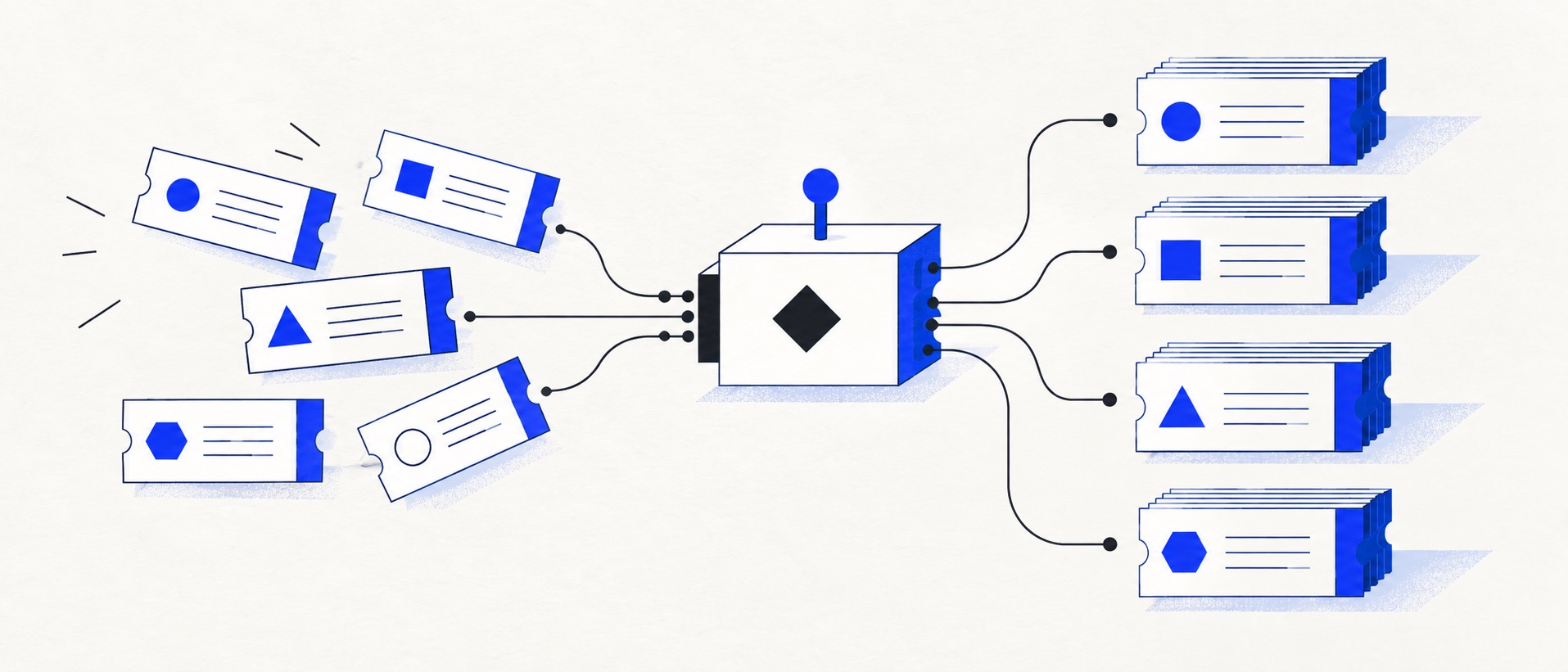
Assignment, collision prevention and searchable history matter before advanced automation.
Compare the tier containing SLAs, routing and reports, not only the advertised entry price.
Test one complete ticket lifecycle and a data export with the people who will run the queue.
Product shortlist
Six ticketing routes for small teams
A good ticketing system should reduce ambiguity. The products differ most in plan shape, customer context, channel depth and whether costs scale by agents or ticket volume.

HelpDesk
Best for: Small teams that want ticketing, website chat and useful automation without an enterprise platform
A focused support workspace combining ticketing, a shared inbox, website chat, messaging channels, automation and reporting in one entry plan.
$19 per user/monthEssential, billed annually; checked September 2026
Useful strengths
- Ticketing, website chat and messaging channels on Essential
- 14-day trial without a credit card
Watch for
- There is no permanent free plan
- Extra AI resolutions can add usage cost
- 14-day trial
- Email, chat and messaging
- Per-user pricing

Freshdesk
Best for: Growing teams that need proper ticketing, self-service, automation and reporting
A broad email-first help desk with ticketing, a shared inbox, a customer portal, knowledge base and out-of-the-box reporting on its entry paid plan.
$19 per agent/monthGrowth, billed annually; checked September 2026
Useful strengths
- Ticketing, shared inbox and knowledge base on Growth
- Clearer route into routing, SLAs and custom reporting
Watch for
- Omnichannel needs differ from the email-first Freshdesk plan
- AI and connector usage can add cost
- Free trial
- Email-first help desk
- Per-agent pricing

Zoho Desk
Best for: Budget-conscious teams and businesses already using the Zoho ecosystem
The free edition covers three users and email ticketing. Paid tiers add broader messaging, knowledge-base, reporting, automation and telephony capabilities in stages.
Free for 3 usersPaid plans vary by selected billing currency; checked September 2026
Useful strengths
- Three-user free edition
- Broad channel and Zoho integration range
Watch for
- Plan and currency selectors make budgeting less immediate
- Live chat and advanced routing are plan-dependent
- 15-day trial
- Free edition
- Three users on free plan

Zendesk
Best for: Teams that expect multiple channels, mature routing and increasing operational complexity
The Support Team plan supplies core email ticketing, routing, analytics and automations. The broader Suite adds live chat, messaging, telephony and a knowledge base.
£15 per agent/monthSupport Team, paid yearly; checked September 2026
Useful strengths
- GBP pricing and a clear entry ticketing plan
- Strong upgrade path for multichannel operations
Watch for
- Suite Team rises to £45 per agent/month
- Small teams may buy more process than they need
- 14-day trial
- GBP pricing available
- Per-agent pricing

HubSpot Service Hub
Best for: Businesses that want support, sales and marketing activity on one customer record
Free tools cover basic ticketing, inbox and live chat. The dedicated advanced help-desk workspace, knowledge base, SLAs and deeper routing are concentrated in Professional and Enterprise.
Free for up to 2 usersProfessional from $90/seat/month annually plus onboarding; checked September 2026
Useful strengths
- Support history beside CRM, sales and marketing data
- Free entry tools and a large integration marketplace
Watch for
- Advanced help desk features require a large price jump
- Professional has mandatory onboarding cost
- 14-day trial
- CRM-connected service
- Two users on free tools

Gorgias
Best for: Online shops that need order context and ecommerce actions inside support conversations
Unlike per-seat tools, Gorgias prices its help desk by billable ticket volume. Its strongest case is the depth of its Shopify and ecommerce workflow integrations.
$10/month for 50 ticketsStarter includes 3 agent seats; checked September 2026
Useful strengths
- Deep Shopify order context and actions
- Costs scale by tickets rather than only by agent seats
Watch for
- Overages and AI resolutions need modelling
- Entry plan is email-only and has limited operations features
- 7-day trial
- Shopify-focused
- Ticket-volume pricing
A small-team ticketing system has one primary job: make every customer request visible, owned and recoverable. It should show what is new, who is replying, what is waiting on the customer and what is overdue. If that foundation is weak, extra dashboards and AI features do not rescue the workflow.
For most teams, HelpDesk is the focused step beyond shared email and Freshdesk is the most balanced conventional help desk. Zoho Desk gives up to three people a permanent free route, while Zendesk is the strongest option for a team intentionally preparing for more complex routing. HubSpot Service Hub is useful when ticket history must sit beside CRM activity. Gorgias changes the equation for ecommerce by connecting tickets to order data and charging around billable volume.
Quick comparison
| System | Best fit | Pricing basis | Operational caution |
|---|---|---|---|
| HelpDesk | Focused ownership and straightforward setup | From $19/user/month annually | Only three ticketing rules on Essential |
| Freshdesk | Balanced ticketing, self-service and reports | From $19/agent/month annually | Advanced routing and multiple SLAs start on Pro |
| Zoho Desk | Free start and Zoho ecosystem | Free for 3 users; paid editions available | Channels and automations are tier-dependent |
| Zendesk | Formal support operations and future complexity | Support Team £15/agent/month annually | Full Suite starts much higher |
| HubSpot | Support tied to CRM, sales and marketing | Free for 2 users; Professional from $90/seat | Advanced help desk requires Professional |
| Gorgias | Ecommerce tickets with order context | From $10/month for 50 billable tickets | Overages matter more than seat count |
Ticketing system versus shared mailbox
A shared mailbox centralises email, but it does not always create a dependable work queue. Team members may still need to signal ownership manually, avoid opening the same message and reconstruct customer history from threads. A ticketing system makes ownership and state explicit.
The move is justified when the cost of ambiguity exceeds the cost of software and setup. Warning signs include duplicate replies, unanswered messages, work forwarded to personal inboxes, no reliable backlog and an inability to calculate response time. Read our detailed guide to shared inboxes versus help desks before paying for a larger platform than the team needs.
The features that matter first
Start with the ticket lifecycle: new, open, waiting, resolved and reopened. Check that agents can assign ownership, leave private notes, use saved replies and see when another person is viewing or drafting. Search should find old conversations by customer, subject and ticket fields.
Then test control. A small team normally needs a few rules for routing, priority or escalation; views for each owner and overdue work; and a report showing volume, first response, resolution time and backlog. Advanced skills-based routing is rarely the first requirement, but a clear path to it can prevent a migration later.
HelpDesk: focused ticket ownership
HelpDesk Essential combines a shared inbox and ticketing with statuses, priorities, automated assignment, canned responses and three ticketing rules. Email, website chat, Messenger and SMS can feed the workspace. At $19 per user each month annually, it is easy to model for a small team.
The limitation is deliberate: teams needing many rules, custom fields, teams and advanced reporting must evaluate the $79 Growth tier. That makes HelpDesk attractive for a contained workflow but less automatic for a process-heavy operation.
Freshdesk: the balanced help desk
Freshdesk Growth includes ticketing, shared inbox, portal, knowledge base, reporting, roles and permissions at $19 per agent each month annually. It covers the normal requirements of a developing support function without starting at enterprise pricing.
The upgrade question is important. Intelligent routing, multiple SLA policies and custom dashboards are Pro features at $55 per agent each month annually. A small team should decide whether those are future needs or present necessities.
Zoho Desk: the free entry route
Zoho Desk's free edition supports three agents, one support email address, web forms and basic help-centre capabilities. It is a practical test for a team moving from email and spreadsheets.
Paid editions expand the channel set, knowledge base, reports and automation. Zoho is especially useful when customer or business data already sits in its wider product family, but the team should document the edition required for every feature before budgeting.
Zendesk: the scaling route
Zendesk Support Team provides email ticketing, routing, prebuilt analytics, prepared responses, customer context and automations for £15 per agent each month when paid yearly. That is not the complete omnichannel product. Suite Team costs £45 per agent and adds the help centre, live chat, messaging, telephony and omnichannel routing.
Choose Zendesk for a genuine expectation of complexity rather than brand recognition. The broader platform is valuable when specialist roles, multiple channels and detailed routing will be used.
HubSpot and Gorgias: context-led alternatives
HubSpot is different because the ticket belongs to a wider customer record. It can be the right system when support must understand leads, deals and marketing interactions. Its free tools support two users, but the advanced help-desk workspace and knowledge base are concentrated in Professional.
Gorgias is different because ecommerce order context is central and subscription cost scales mainly by billable ticket volume. Shopify-connected teams can view order details and carry out actions such as refunds or cancellations from the support workspace. Model seasonal ticket peaks and overages before choosing it.
How to run a fair ticketing trial
Use 20 representative conversations: a simple question, a complaint, a refund, a technical issue, a duplicate, a VIP customer and an issue that must escalate. Assign and reassign work, add an internal note, create a rule, miss a response target deliberately, reopen a ticket and export the history.
The winning system should make the queue clearer after that test. If the team needs a manual spreadsheet to compensate for weak views or reporting, the software has not solved the original problem.
Our verdict
HelpDesk is the simplest focused paid starting point; Freshdesk is the best-balanced conventional ticketing package; and Zoho Desk is the clearest free route. Zendesk suits a team buying for operational depth, HubSpot suits CRM-led support, and Gorgias suits ecommerce.
Do not choose by ticket count alone. Choose the least complex system that makes ownership, priority, response targets and customer history reliable at the next realistic team size.
Sources
- HelpDesk pricing
- Freshdesk pricing
- Zoho Desk pricing
- Zendesk UK pricing
- HubSpot Service Hub pricing
- Gorgias plan guide
All plan facts come from provider sources. Product-fit conclusions are Support Sorted's editorial judgement.
Frequently asked questions
Questions readers ask before choosing
What is a ticketing system for customer support?
A ticketing system turns incoming customer messages into trackable records with an owner, status, priority and history. It helps a team prevent duplicate replies, find outstanding work and report on response and resolution performance.
What is the best free ticketing system for a small team?
Zoho Desk is the clearest permanent free option in this shortlist because its free edition supports three users. HubSpot also offers free service tools for up to two users when CRM context and live chat are useful.
How many tickets does a small team need before using a help desk?
There is no fixed threshold. Move when ownership becomes unclear, messages are missed, two people can answer the same request or managers cannot see the backlog. Operational risk is a better trigger than raw ticket count.
Which ticketing features should a small team prioritise?
Prioritise assignment, collision detection, internal notes, saved replies, views, search, basic automation, response targets and export. Add advanced routing and AI only when the queue is stable enough to use them well.