
Head-to-head comparison
HelpDesk vs Freshdesk
Compare HelpDesk vs Freshdesk beyond the $19 headline, with channel and knowledge-base requirements, rule-limit scenarios and two- and five-user upgrade costs.
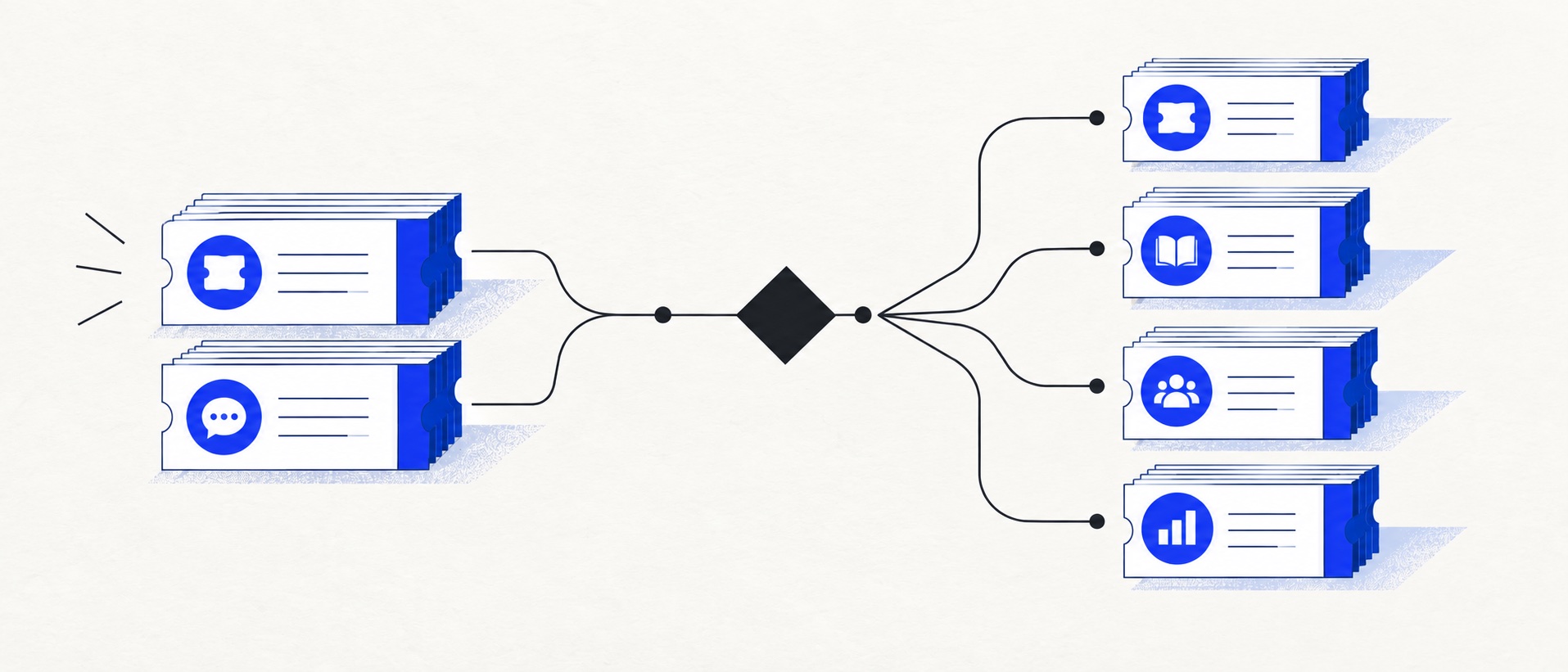
The identical headline price hides a different package: compare chat and inbox focus with portal and knowledge depth.
HelpDesk is easier to justify for a small queue; Freshdesk provides more room for service policies, routing and reporting growth.
Count HelpDesk rules and AI usage, then map Freshdesk requirements to Growth or Pro before deciding.
Product shortlist
HelpDesk and Freshdesk side by side
Official product logos make the alternatives easy to identify.

HelpDesk
Best for: Small teams that want ticketing, website chat and useful automation without an enterprise platform
A focused support workspace combining ticketing, a shared inbox, website chat, messaging channels, automation and reporting in one entry plan.
$19 per user/monthEssential, billed annually; checked September 2026
Useful strengths
- Ticketing, website chat and messaging channels on Essential
- 14-day trial without a credit card
Watch for
- There is no permanent free plan
- Extra AI resolutions can add usage cost
- 14-day trial
- Email, chat and messaging
- Per-user pricing

Freshdesk
Best for: Growing teams that need proper ticketing, self-service, automation and reporting
A broad email-first help desk with ticketing, a shared inbox, a customer portal, knowledge base and out-of-the-box reporting on its entry paid plan.
$19 per agent/monthGrowth, billed annually; checked September 2026
Useful strengths
- Ticketing, shared inbox and knowledge base on Growth
- Clearer route into routing, SLAs and custom reporting
Watch for
- Omnichannel needs differ from the email-first Freshdesk plan
- AI and connector usage can add cost
- Free trial
- Email-first help desk
- Per-agent pricing
HelpDesk and Freshdesk share a $19 annual-billing entry price, but they solve the next layer of the support problem differently. HelpDesk puts ticketing, a shared inbox, website chat and messaging into a focused product. Freshdesk Growth combines email ticketing with a customer portal, knowledge base and standard analytics, then offers a broader path into advanced routing and service management.
Choose HelpDesk for a contained email-and-chat support queue. Choose Freshdesk for broader self-service and a more developed ticket-operation path. Neither wins simply because its price is shown first.
Quick comparison
| Area | HelpDesk Essential | Freshdesk Growth |
|---|---|---|
| Annual price | $19/user/month | $19/agent/month |
| Core strength | Focused inbox plus website chat | Ticketing, portal, knowledge and analytics |
| Automation point | Three ticketing rules on Essential | Broader workflow; intelligent routing in Pro |
| Trial | 14 days, no card required | Free trial available |
| Main cost risk | Higher plan and added AI resolutions | Growth-to-Pro jump from $19 to $55 |
At five users, either entry plan is $95 each month before tax on annual terms. The decisive difference is what the team receives at that level and what forces the first upgrade.
Our requirement-gap analysis: the equal price is only a starting point
Take an illustrative two-person business replacing shared email. Before pricing it, write one sentence naming the next essential function: staffed website chat, public help articles, more ticketing rules or a custom management dashboard. Those additions lead to different candidates even though both products advertise $19 entry seats.
| Must-have beyond email ownership | HelpDesk starting candidate | Freshdesk starting candidate |
|---|---|---|
| Staffed website chat | Essential: 2 × $19 × 12 = $456 | Reprice the relevant Omni configuration; standard Growth is not a matched chat quote |
| Built-in public knowledge base and customer portal | Public self-service not established by the cited plan evidence; do not assume Growth solves the gap | Growth: $456 |
| 4 independent mandatory ticketing rules | Growth's 10-rule capacity: 2 × $79 × 12 = $1,896 | Check the exact actions against Growth automation before selecting a tier |
| Custom reporting dashboard | Verify the required report; Growth performance reporting does not establish every custom dashboard | Pro: 2 × $55 × 12 = $1,320 |
The facts come from HelpDesk's plan comparison and Freshdesk's pricing. An unknown is a decision gap, not a zero-cost feature. HelpDesk's knowledge sources for AI are also not evidence of a public customer help centre. Freshdesk's standard Growth rate is not an omnichannel quote merely because the same provider sells Omni.
Compare the upgrade rather than the plan name
At two full users, the annual bases are $456 for either entry tier, $1,896 for HelpDesk Growth and $1,320 for Freshdesk Pro. At five they are $1,140, $4,740 and $3,300 respectively. HelpDesk Growth versus Freshdesk Pro has a base difference of $576 a year for two people or $1,440 for five. That is not a like-for-like verdict: the required channel or reporting function must still be covered by both selected configurations.
This matters particularly for a rule-limit upgrade. Write each independent rule's trigger and action, then mark whether it is mandatory or merely convenient. If four are genuinely required and cannot fit Essential's three-rule limit, HelpDesk's higher-tier base belongs in the budget. Do not automatically assign Freshdesk Pro to the same scenario: ordinary automation and Pro intelligent routing are different requirements. Equally, do not declare Freshdesk Growth suitable until the particular conditions and actions are verified.
A second tool can overturn the apparent saving
If the HelpDesk route needs a separately maintained public help library, call its annual incremental cost K. Include its subscription, necessary connector charges and implementation effort on separate lines. If the Freshdesk route needs additional channels, record the complete eligible package price rather than treating an unpriced chat requirement as zero. Comparing $456 against $456 while leaving K or the channel upgrade blank does not produce a completed budget.
Our recommendation therefore favours Essential when email and website chat are the real brief, and Growth when email plus built-in self-service is the brief. More advanced controls require a new plan-level comparison. Keep AI costs separate as well: one provider's resolution is not automatically another's session. The AI unit guide explains that denominator problem, while the HelpDesk and Freshdesk reviews supply their individual upgrade calculations.
Queue and collaboration
Both products provide the core improvement over a shared mailbox: messages become tickets with visible owners, statuses and history. Agents can collaborate privately, use prepared replies and avoid two people unknowingly answering the same customer.
HelpDesk's narrower product shape is an advantage when the operating model is simple. A team can connect its address, create groups and saved replies, and use automated assignment without designing a large service taxonomy. Owners who administer support alongside another job may value that focus.
Freshdesk supports the same essential work and gives more room for roles, tasks, threads and a growing group structure. This is helpful when support is already becoming a defined function. It can also invite unnecessary setup if a two-person team copies an enterprise workflow.
Verdict: HelpDesk for minimum administrative weight; Freshdesk for an organisation that expects its queue structure to deepen.
Live chat, messaging and channels
HelpDesk Essential includes website chat alongside email ticketing and lists Messenger and SMS among its channel capabilities. That makes it a direct option for a small business wanting one workspace for email and a staffed website conversation.
Freshdesk Growth is best understood as email-first. Freshworks separates broader omnichannel needs into Freshdesk Omni. If chat, social messaging or voice are central, the buyer should compare that package and price rather than assuming the $19 Growth plan covers the same scope as HelpDesk.
A channel is only valuable when staffing matches the promise. Test after-hours behaviour, chat-to-ticket handover, customer identity and notification control. HelpDesk wins this category for the simpler email-and-website-chat requirement; Freshworks can cover broader needs through a different package.
Knowledge base and self-service
Freshdesk has a decisive advantage for built-in self-service. Growth includes a customer portal and knowledge base, allowing a team to publish common answers and give customers a consistent help destination. Pro extends the proposition for multiple products and languages.
HelpDesk's core case is assisted support rather than a broad knowledge platform. A business could use separate documentation, but that adds another system and weakens the all-in-one comparison. If maintaining a connected public help centre is a firm requirement, Freshdesk is the clearer choice.
The feature still requires editorial discipline. Begin with ticket-backed topics, assign an owner and review unsuccessful searches. Buying Freshdesk because a knowledge-base box is ticked creates no value unless the team will maintain it.
Automation, AI and routing
HelpDesk Essential includes automated assignment and three ticketing rules. That can cover a useful small-team baseline, but the number should be tested against real conditions. Billing, urgent, product area and customer tier can consume three rules before other needs are considered.
HelpDesk also includes a small AI-resolution allowance on Essential, with additional usage potentially adding cost. Separate the value of deterministic rules from AI outcomes, and measure how often a supposedly resolved conversation returns.
Freshdesk offers conventional automation and moves intelligent routing and multiple SLA policies into Pro at $55 per agent each month annually. Pro is a stronger operational toolkit, but its price should be modelled at full headcount. Freshdesk wins for advanced routing depth; HelpDesk is sufficient when a few transparent rules cover the queue.
Reporting and service management
Freshdesk Growth includes out-of-the-box analytics, giving it the stronger baseline management proposition. Pro adds custom dashboards and multiple service policies. A growing support lead can use these capabilities to understand categories, workload and target risk.
HelpDesk includes reporting suitable for monitoring a focused queue. During evaluation, check exact filters, business-hour treatment and definitions for response and resolution. A smaller report set can be perfectly adequate if it answers weekly operational questions without manual spreadsheets.
Choose based on decisions rather than dashboard count. If management needs custom segmentation by product, group and contract, Freshdesk Pro is more likely to fit. If the goal is to spot backlog, response risk and agent workload, HelpDesk may remain the more economical operating choice.
Pricing and upgrade points
The entry-plan tie ends when requirements grow. HelpDesk Essential can become expensive if a necessary capability forces a substantially higher plan, and AI volume adds another variable. Obtain the exact higher-tier quote that matches the next twelve months.
Freshdesk Growth to Pro is transparent but material: five agents move from $95 to $275 a month on annual billing. Multiple SLA policies, intelligent routing and custom dashboards must create enough operational value to justify the $180 monthly difference.
An upgrade trigger should be observable. If the HelpDesk trial needs four independent routing rules, Essential's three-rule allowance is already a constraint; confirm the next plan and price before buying. If a Freshdesk trial needs two distinct SLA policies, model Pro from day one instead of reporting Growth as the likely cost. Conversely, if the team can operate with one policy and ordinary assignment, a higher-tier feature list is not evidence that the higher tier is necessary.
Build a three-case model for today's team, the next hiring point and the first advanced workflow. Include tax, annual commitment, channel packages, AI usage and implementation time. The cheaper result depends on where each product's boundary meets the real process.
Ease of setup and administration
HelpDesk's documented proposition centres on an inbox and chat, making it a candidate for a contained initial brief. That does not remove the need to define ownership, status and escalation, and a narrower feature list alone does not establish a shorter implementation time.
Freshdesk offers more settings and a longer path. Its administrative weight is reasonable for a support function that will use the portal, knowledge and reporting. Assign a product owner so fields, rules and views do not proliferate.
Test both with a new agent who did not attend setup. Ask that person to find the next ticket, see customer history, leave an internal note and escalate. Ease of use should be judged through successful work, not the number of minutes in an interface tour.
Which product is best for your team?
Choose HelpDesk if support is mostly email and website chat, the team wants rapid clarity and three core rules cover the process. It suits organisations that see a focused support tool as a strength.
Choose Freshdesk if a knowledge base and portal are immediate requirements, managers need baseline analytics, or the business expects multiple service policies and intelligent routing later. Growth is the value point; Pro should be a deliberate forecast.
Consider Zoho Desk for permanent free entry, HubSpot for CRM-connected service, Zendesk for complex multichannel operations and Gorgias for Shopify-focused support.
A fair trial
Use the same inbox, agents and ten representative enquiries. Test assignment, duplicate prevention, chat handover, one urgent rule, a reopened ticket and a report. In Freshdesk, publish and use a knowledge article. In HelpDesk, count the exact rules needed and monitor included AI usage.
Record the time to administer each workflow, not only agent clicks. Map every capability to Essential, Growth, Pro or another required package. A fair trial exposes where the identical $19 headline stops being comparable.
Final verdict
HelpDesk is the better choice for a team that wants a focused email-and-chat workspace with minimal ceremony. Freshdesk is the stronger all-round support system when self-service, reporting and an advanced ticketing path matter.
At entry level, the decision should be made on scope rather than price because the annual-billing headline is the same. The best product is the one whose first plan covers the full current workflow and whose upgrade point matches a genuine future need.
Sources
All plan facts come from provider sources. Product-fit conclusions are Support Sorted's editorial judgement.
Frequently asked questions
Questions readers ask before choosing
Which is cheaper, HelpDesk or Freshdesk?
Both advertise an entry paid plan at $19 per user or agent each month on annual billing. HelpDesk Essential is $25 monthly; Freshdesk's higher Pro tier is $55 annually. Compare the tier, user count, AI usage and channels required.
Is HelpDesk easier than Freshdesk?
HelpDesk has a more contained proposition and can be easier for a small team whose main problem is shared-inbox ownership. Freshdesk has broader ticketing, self-service and reporting depth, which adds capability and administration.
Which is better for a knowledge base?
Freshdesk is the stronger choice because Growth includes a customer portal and knowledge base, with more advanced content capabilities in Pro. HelpDesk should be chosen primarily for its queue, chat and focused collaboration.
Which is better for live chat?
HelpDesk includes website chat in its Essential proposition, making it the more direct choice for an email-and-chat small team. Freshdesk's standard plans are email-first; broader channel needs should be compared with Freshdesk Omni.
Is HelpDesk Growth the same as Freshdesk Growth?
No. The shared plan name hides different tiers. HelpDesk Growth is $79 per user each month on annual billing, whereas Freshdesk Growth is $19 per agent. Five users give annual bases of $4,740 and $1,140 respectively, but their channels, controls and usage allowances still need a requirements comparison.