
Team and business fit
Support software for subscription-box businesses
Choose and configure support software for recurring boxes, renewal dates, address changes, skipped deliveries, failed payments and returns.
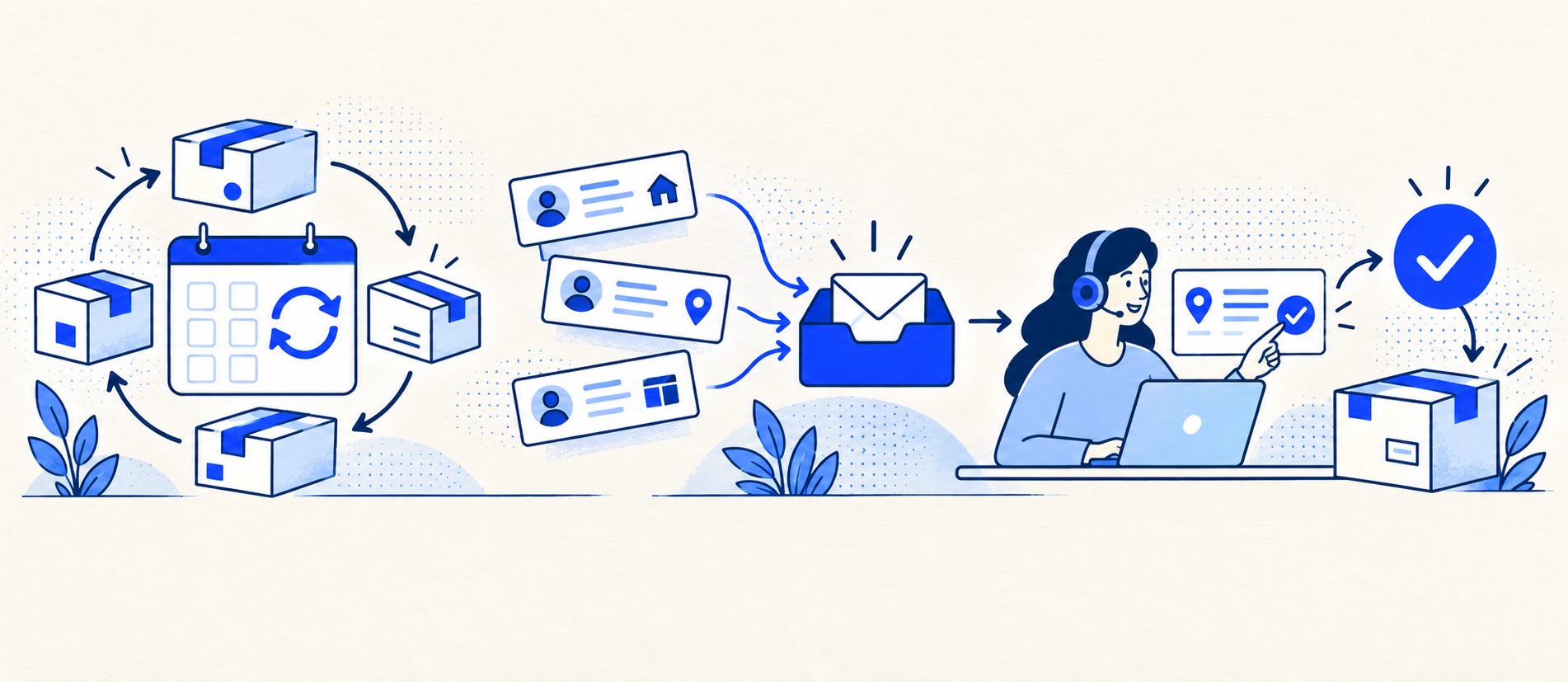
Distinguish order, subscription contract and future fulfilment cycle.
Route time-sensitive skip and address changes before cut-off.
Give customers safe self-service for routine changes and a human exception path.
Product shortlist
Support platforms to test for recurring commerce
A Shopify order sidebar does not necessarily expose subscription contracts. Test the subscription app or billing integration you actually use and the cut-off workflow before choosing a help desk.

Gorgias
Best for: Online shops that need order context and ecommerce actions inside support conversations
Unlike per-seat tools, Gorgias prices its help desk by billable ticket volume. Its strongest case is the depth of its Shopify and ecommerce workflow integrations.
$10/month for 50 ticketsStarter includes 3 agent seats; checked September 2026
Useful strengths
- Deep Shopify order context and actions
- Costs scale by tickets rather than only by agent seats
Watch for
- Overages and AI resolutions need modelling
- Entry plan is email-only and has limited operations features
- 7-day trial
- Shopify-focused
- Ticket-volume pricing

Freshdesk
Best for: Growing teams that need proper ticketing, self-service, automation and reporting
A broad email-first help desk with ticketing, a shared inbox, a customer portal, knowledge base and out-of-the-box reporting on its entry paid plan.
$19 per agent/monthGrowth, billed annually; checked September 2026
Useful strengths
- Ticketing, shared inbox and knowledge base on Growth
- Clearer route into routing, SLAs and custom reporting
Watch for
- Omnichannel needs differ from the email-first Freshdesk plan
- AI and connector usage can add cost
- Free trial
- Email-first help desk
- Per-agent pricing

Zendesk
Best for: Teams that expect multiple channels, mature routing and increasing operational complexity
The Support Team plan supplies core email ticketing, routing, analytics and automations. The broader Suite adds live chat, messaging, telephony and a knowledge base.
£15 per agent/monthSupport Team, paid yearly; checked September 2026
Useful strengths
- GBP pricing and a clear entry ticketing plan
- Strong upgrade path for multichannel operations
Watch for
- Suite Team rises to £45 per agent/month
- Small teams may buy more process than they need
- 14-day trial
- GBP pricing available
- Per-agent pricing

HubSpot Service Hub
Best for: Businesses that want support, sales and marketing activity on one customer record
Free tools cover basic ticketing, inbox and live chat. The dedicated advanced help-desk workspace, knowledge base, SLAs and deeper routing are concentrated in Professional and Enterprise.
Free for up to 2 usersProfessional from $90/seat/month annually plus onboarding; checked September 2026
Useful strengths
- Support history beside CRM, sales and marketing data
- Free entry tools and a large integration marketplace
Watch for
- Advanced help desk features require a large price jump
- Professional has mandatory onboarding cost
- 14-day trial
- CRM-connected service
- Two users on free tools
A subscription-box customer may contact support about an order that shipped last week, a box due next month, a renewal charge, a skipped delivery or an address they want changed before packing starts. A normal ecommerce help desk often shows the latest order well but not the future subscription state. That gap can lead an agent to promise a pause when the next box is already committed to fulfilment.
Shopify Subscriptions provides a useful example of the distinction. Its documentation describes a subscription contract with products, quantity, frequency and status, and separate recurring orders. It also documents customer-account actions for skipping, pausing, cancelling and updating payment or shipping details. A store using a third-party subscription app may have different controls and reminders. Verify the exact system in use.
Map the three records
For every common support request, identify the customer profile, the subscription contract and the relevant order or shipment. These are not interchangeable. A failed payment may leave a contract active but block an order. A customer may skip the next order without cancelling the contract. An address changed on the customer profile may not update a parcel already dispatched. Write the authoritative system and owner for each record.
Give the support team a view or safe link to the next charge date, next box cut-off, delivery address, selected products, payment state and recent changes. If the help desk cannot show all of this, an internal checklist is better than pretending the last order tells the whole story.
Prioritise cut-off-sensitive requests
Create a queue for “skip next box”, “change address”, “swap item” and “cancel before renewal”. Record the promised cut-off and the fulfilment cut-off separately. Route these tickets ahead of general product questions when a delay will remove the customer's choice. A rule should flag urgency, not automatically promise that a change succeeded.
Test the actual path for a request arriving just before, at and after the cut-off. What happens if an agent edits the contract while the warehouse has already created the order? Who reconciles conflicting states? The customer-facing reply should distinguish “we received your request” from “the change is confirmed for the next box”.
Use self-service without hiding support
Link directly to the authenticated subscription-management route in renewal emails and help articles. Shopify says customers using Shopify Subscriptions can manage payment, address, skip, pause and cancellation from their account when configured. Its upcoming-order reminder is sent three days before a recurring charge for subscriptions managed by that app; a third-party provider may use another schedule. Do not copy that timing into your help centre unless it is true for your store.
Keep a human route for failed login, disputed charge, accessibility needs, an order already in fulfilment or a gift purchased by someone else. A public knowledge-base article can explain the process, but it cannot safely show a customer's private contract or change a payment method.
Handle billing and cancellations carefully
Never collect card information through a support ticket. Use the billing platform's authenticated update link. For cancellation, verify whether the request means “stop future renewals”, “stop the box already charged” or “refund the latest order”. Those can require different actions. Shopify notes that a cancelled subscription contract cannot simply be resumed; a new order may be needed. An agent should understand the consequence before clicking.
Record the exact action and confirmation from the subscription system. If the customer has multiple contracts, name which one changed. When a payment fails, route to an approved recovery process rather than treating the ticket as a generic delivery delay.
Compare software using a full cycle
Test a new signup, successful renewal, skipped box, changed address, failed payment, cancellation and later return. The help desk should keep the conversation history alongside an unambiguous customer and contract reference. Evaluate whether Gorgias or a general ticketing tool can show your subscription app's data through a current integration; do not assume “Shopify integration” means contract visibility.
Report support contacts per active subscriber and per shipment, broken down by billing, address, skip, fulfilment and cancellation. A seasonal rise in active contracts may hide a worsening contact rate. Sample the complaints that occur immediately after renewal: they often reveal unclear reminders, cut-offs or account controls rather than a need for another chatbot.
Sources
- Shopify guide to managing subscription contracts
- Shopify Subscriptions customer experience
- Shopify guide to viewing customer subscriptions
Shopify-specific capabilities come from its documentation. Workflow and help-desk fit are Support Sorted's editorial judgement.
Frequently asked questions
Questions readers ask before choosing
Why is an order integration not enough for a subscription box?
An order describes one purchase or shipment. The subscription contract governs future frequency, next charge, skip, pause and cancellation state, which may live in a separate app.
Can customers change their own delivery address?
Shopify Subscriptions documents customer-account controls for address and payment changes when its subscription management is enabled. Other subscription apps differ; test the actual customer route and cut-off time.
Should support agents take payment details in tickets?
No. Direct customers to the approved authenticated payment-update flow. Do not ask them to email card information or paste it into chat.
What is the most important automation for a subscription-box team?
Route time-sensitive changes before the next charge or fulfilment cut-off. A generic fast acknowledgement is less useful than identifying requests that will become impossible to action later.