
Product review
Zendesk review
Our Zendesk review explains UK Support and Suite pricing, ticketing, knowledge base, omnichannel routing and the fit for growing service teams.
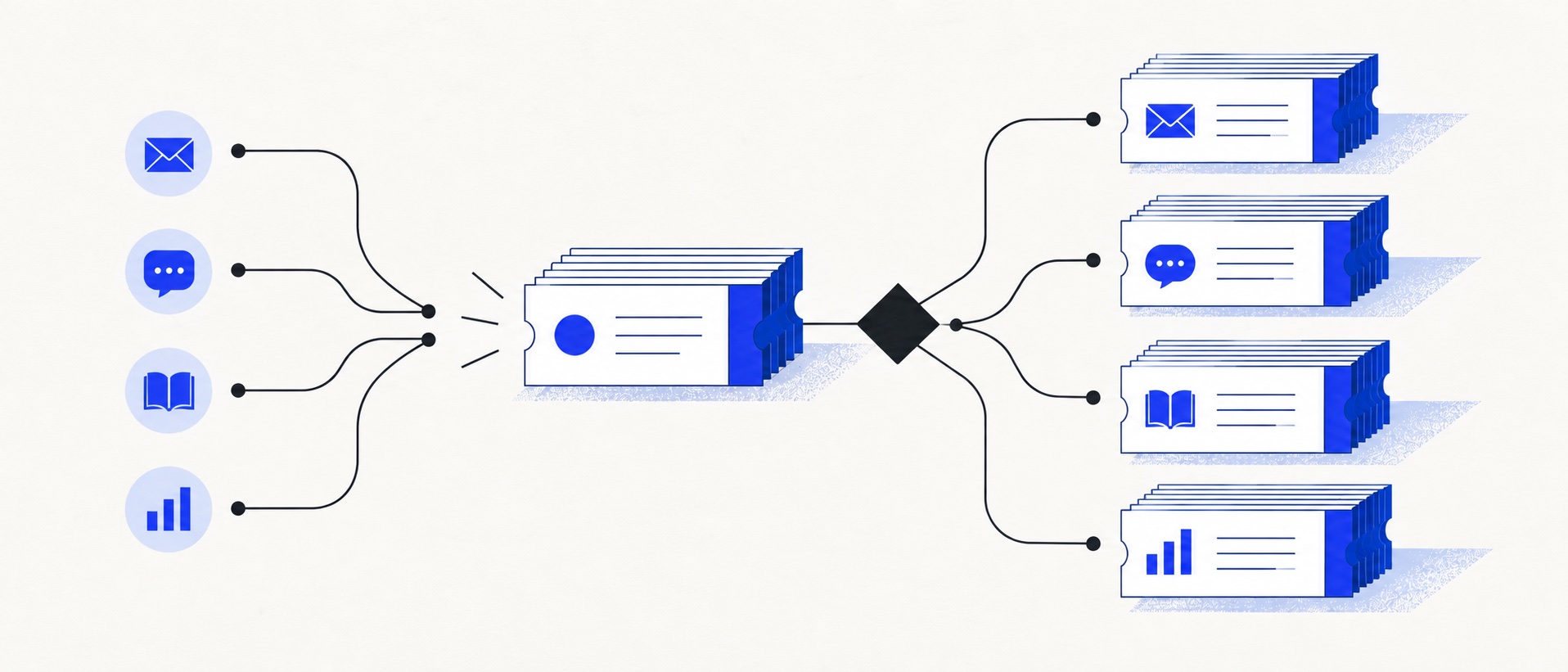
Separate Support Team from Suite Team when comparing prices; they cover materially different channel and self-service needs.
Zendesk is strongest where routing, roles and operational complexity are expected to grow.
A very small email-only team may receive better value from a more focused product with less administration.
Product shortlist
Zendesk at a glance
The official Zendesk logo accompanies a normal provider link.

Zendesk
Best for: Teams that expect multiple channels, mature routing and increasing operational complexity
The Support Team plan supplies core email ticketing, routing, analytics and automations. The broader Suite adds live chat, messaging, telephony and a knowledge base.
£15 per agent/monthSupport Team, paid yearly; checked September 2026
Useful strengths
- GBP pricing and a clear entry ticketing plan
- Strong upgrade path for multichannel operations
Watch for
- Suite Team rises to £45 per agent/month
- Small teams may buy more process than they need
- 14-day trial
- GBP pricing available
- Per-agent pricing
Zendesk is one of the best-known names in customer support, but brand recognition is not a purchasing requirement. Its real strength is the route from core email ticketing to a broad service operation with messaging, voice, knowledge, automation, reporting and mature routing.
Our view is that Zendesk is a strong scaling platform for teams that expect operational complexity. It is less persuasive as a default purchase for two people who only need to stop sharing an inbox. The product has an accessible £15 entry price, yet the £45 Suite Team plan is the more honest starting comparison for many multichannel buyers.
This review is grounded in Zendesk's current UK pricing and product documentation.
Zendesk UK pricing
| Plan | Annual-billing price | Core position |
|---|---|---|
| Support Team | £15 per agent/month | Email ticketing, routing, analytics, prepared responses and automations |
| Suite Team | £45 per agent/month | Adds knowledge, messaging, live chat, telephony and omnichannel routing |
| Suite Professional | £89 per agent/month | More advanced service management and operational controls |
The clean GBP display helps UK budgeting, but the plan family is more important than the currency. Five Support Team seats cost £75 a month on annual terms; five Suite Team seats cost £225. Comparing Support Team with a rival's broader omnichannel package would make Zendesk appear cheaper while omitting functions that drove the original requirement.
Additional AI, workforce, quality or other capabilities may be separately packaged. Build the budget from the actual configuration, annual commitment and agent count. If a startup promotion applies, model the first normal renewal at full price before making Zendesk the system of record.
Our bundle analysis: compare the same service promise
A Zendesk comparison should begin with what customers are promised, not the lowest price in the table. Our illustrative two-agent email operation needs ownership, prepared responses and baseline reporting. Support Team is a credible candidate for that brief. Change the promise to include website messaging and a maintained public knowledge base, and Suite Team becomes the relevant starting bundle. Zendesk's UK plan descriptions identify that difference.
These are purchasing scenarios, not observed customer outcomes. The following calculation holds agent count constant so the effect of buying the broader bundle is visible.
| Agents | Support Team: £15 × agents × 12 | Suite Team: £45 × agents × 12 | Bundle uplift |
|---|---|---|---|
| 2 | £360 | £1,080 | £720 |
| 5 | £900 | £2,700 | £1,800 |
The annual uplift is £360 per agent, regardless of whether the illustrative team has two or five people. A competitor with included customer self-service should be compared with the eligible Zendesk bundle, not automatically with Support Team. Otherwise the saving is partly an omitted requirement rather than a genuine price advantage.
A second boundary: routing by skills
Suite Team's omnichannel routing should not be treated as proof that every advanced assignment method is included. The current pricing page identifies skills-based routing on Suite Professional. If matching work to a defined skill is non-negotiable, the budget must therefore examine that tier rather than stop at Suite Team.
For five agents, Suite Professional's £89 annual monthly equivalent gives 5 × £89 × 12 = £5,340 a year. The difference from five Suite Team seats is £2,640. That is the whole base-tier difference, not a standalone price for a skills-routing feature. Other included functions may matter, but count only the ones the business intends to use. Customised agent roles are listed still higher, on Enterprise + Copilot; do not infer that Professional satisfies a custom-permissions requirement merely because it is an advanced plan.
Put the premium into an operating decision
Suppose a five-agent business is considering Suite Team instead of Support Team. The £1,800 difference is £150 a month. With an illustrative £25 internal productive-hour cost, the labour-only hurdle is six hours a month. This is an assumed break-even benchmark, not a claimed Zendesk efficiency gain. Alternatively, the broader bundle may avoid a separate tool bill; compare the actual replaceable subscription and migration effort, rather than crediting the entire current software stack as a saving.
Our recommendation changes with the brief. Keep Support Team in the comparison for email-only service. Consider Suite Team for the named messaging and knowledge requirements. Consider Professional when the required assignment or management control is documented at that tier. If nobody can own configuration and maintain the additional channels, the broader product is not automatically the better operational choice.
Finally, these totals are subscription bases, not maximum bills. Voice consumption, AI outcomes, paid apps and other usage can remain separate; an included capability is not evidence of unlimited included consumption. Use the procurement checklist to record those conditions and the total-cost model to keep them outside the seat arithmetic.
Core ticketing on Support Team
Support Team contains the foundation for a disciplined email operation. Messages become tickets with ownership, status and customer context. Agents can use prewritten responses, and automations and triggers can apply routine logic. Prebuilt analytics give managers a way to see queue performance without building a custom reporting project.
This may be all an email-led business needs. A team should not buy Suite purely because it is the more widely marketed package. If the actual process is one support address, a handful of agents and simple escalation, Support Team deserves a direct trial against HelpDesk Essential and Freshdesk Growth.
Zendesk's administrative depth becomes visible quickly. Fields, forms, views, groups, triggers and automations can produce a precise workflow, but they also need governance. Name an owner for configuration and document why each rule exists. Otherwise, the queue can behave correctly for reasons nobody remembers.
What Zendesk Suite adds
Suite Team expands the proposition beyond an email help desk. It adds a knowledge base, web and social messaging, live chat, telephony and omnichannel routing. That combination is relevant when a customer may begin in one channel and an agent needs a single operational workspace.
The knowledge capability lets a business publish help content and connect self-service with assisted support. As with every platform, buying the feature does not create useful documentation. Select high-volume contact reasons, assign article ownership and review failed searches and ticket-after-article behaviour.
Voice and messaging also change staffing expectations. A support email can wait in a queue; a live conversation creates an immediate promise. Test capacity controls, handover and after-hours behaviour before enabling a channel publicly.
Omnichannel routing and service operations
Zendesk's omnichannel routing can assign work across channels using availability and capacity. This is one of the clearest reasons to choose the Suite for a larger or specialised team. It helps move distribution from informal picking towards a managed workload.
Routing is only as reliable as its inputs. Define which agents can handle each type of work, what “available” means and how urgent tickets override normal order. Run absences, busy periods and escalation through the trial. A perfect demonstration with every agent online says little about a difficult Monday morning.
Small teams should resist unnecessary sophistication. With two generalists, a visible unassigned queue may be more dependable than a detailed capacity model. Zendesk is most valuable when its controls solve real coordination problems rather than signalling that the company owns an enterprise product.
Analytics, automation and AI
Prebuilt reporting on Support Team covers a useful baseline; broader plans extend the analytical proposition. Start with operational decisions: staffing a time period, fixing a repeated issue, maintaining a service promise or identifying reassignment. Then verify that the relevant metric, filter and history are included.
Triggers act when a ticket is created or updated, while time-based automation can handle ageing work. Keep conditions mutually understandable and add a naming convention. Test for loops, contradictory actions and tickets that meet more than one rule.
Zendesk promotes AI throughout its service platform. Buyers should treat AI as a separately measured layer. Ask what is included, which action consumes usage, how a resolution is defined, how a person takes over and whether reporting distinguishes automated from human service. Those answers matter more than a broad AI label.
Administration and implementation
Zendesk can support a mature operating model, which means implementation deserves time. Map channels, groups, forms, permissions, service targets and escalation before importing historical data. Launch a minimum viable queue, observe it, and add complexity only where evidence supports it.
Training should cover how agents choose status, when they use internal notes, how they escalate and where customer context belongs. Inconsistent status use makes even powerful reporting unreliable. Managers also need to understand metric definitions before setting targets.
Export and offboarding deserve an early test. Confirm what ticket, user, attachment and knowledge data can be retrieved and in which format. Portability is part of product quality even when the team expects to stay for years.
Zendesk's limitations
Cost rises materially from Support Team to Suite Team. That is not hidden, but it can be overlooked when buyers compare headline figures. Add-ons can widen the difference further.
The product can also create administrative overhead for a small operation. A dedicated service manager may appreciate the configuration; an owner doing support between other work may prefer HelpDesk's narrower scope or Freshdesk's balanced Growth plan.
Finally, Zendesk is a general service platform. Gorgias is often more direct for a Shopify store because ecommerce context and order actions are central to the workspace. HubSpot can be the better strategic choice when the shared CRM record matters more than specialised service controls.
Who should choose Zendesk?
Choose Zendesk when the team expects multiple channels, specialist groups, stronger routing and a defined support operation. Support Team fits a disciplined email queue; Suite fits businesses that need connected messaging, knowledge and voice. The platform is particularly sensible when the buyer can name the complexity it will solve.
Do not choose it solely because it is familiar. A small business with five agents would pay £2,700 a year for Suite Team before tax, compared with £900 for Support Team. Both can be appropriate; neither is automatically the right value.
Trial plan
Test Support Team and Suite requirements separately. Process representative emails, configure one trigger and one time-based automation, report on response and resolution, and export a sample. For Suite, add a knowledge article, a messaging handover and one voice or omnichannel routing scenario if those are genuine requirements.
Ask an administrator to make a controlled change and a new agent to work without a guided tour. Record plan, add-on and implementation assumptions beside each task. This reveals whether Zendesk's depth is productive for the team or simply impressive during evaluation.
Final verdict
Zendesk remains a credible shortlist product because it has both a capable ticketing entry point and a broad route into mature service. Its UK pricing is clear once Support and Suite are treated as different propositions.
For a complex or deliberately scaling operation, that route can justify the administration and cost. For a simple inbox, start with the £15 Support Team requirement and compare focused alternatives. Zendesk is strongest when a business buys its operational depth intentionally.
Sources
- Zendesk UK pricing
- Zendesk Suite plan types
- Zendesk omnichannel routing overview
- Getting started with Zendesk Suite
All plan facts come from provider sources. Product-fit conclusions are Support Sorted's editorial judgement.
Frequently asked questions
Questions readers ask before choosing
How much does Zendesk cost in the UK?
Zendesk advertises Support Team at £15 per agent each month on annual billing. Suite Team is £45 and Suite Professional £89 per agent each month annually. Prices were checked in September 2026 and exclude applicable tax and add-ons.
What is the difference between Zendesk Support and Zendesk Suite?
Support Team focuses on core email ticketing, routing, analytics and automation. Suite Team adds the wider service package, including a knowledge base, messaging, live chat, telephony and omnichannel routing.
Is Zendesk too complex for a small business?
Not always, but a small team should have a clear reason for choosing it. Zendesk makes most sense when the business expects multiple channels, specialist roles or more mature routing. A simple two-person inbox may be easier and cheaper elsewhere.
Does Zendesk offer a free plan?
Zendesk does not advertise a permanent free help-desk edition. A trial is available, and eligible startups may have access to a time-limited programme. Model the normal post-trial or post-programme cost before adopting it.
What does moving from Support Team to Suite Team cost?
At the published UK annual-billing rates, the difference is £30 per agent each month, or £360 per agent a year, before tax and usage. Two agents add £720 annually and five add £1,800. Suite provides a broader bundle; those amounts do not establish a measured service improvement.