
Product review
HelpDesk review
Our HelpDesk review explains its current pricing, ticketing, automation, AI allowances and fit for UK small teams moving beyond shared email.
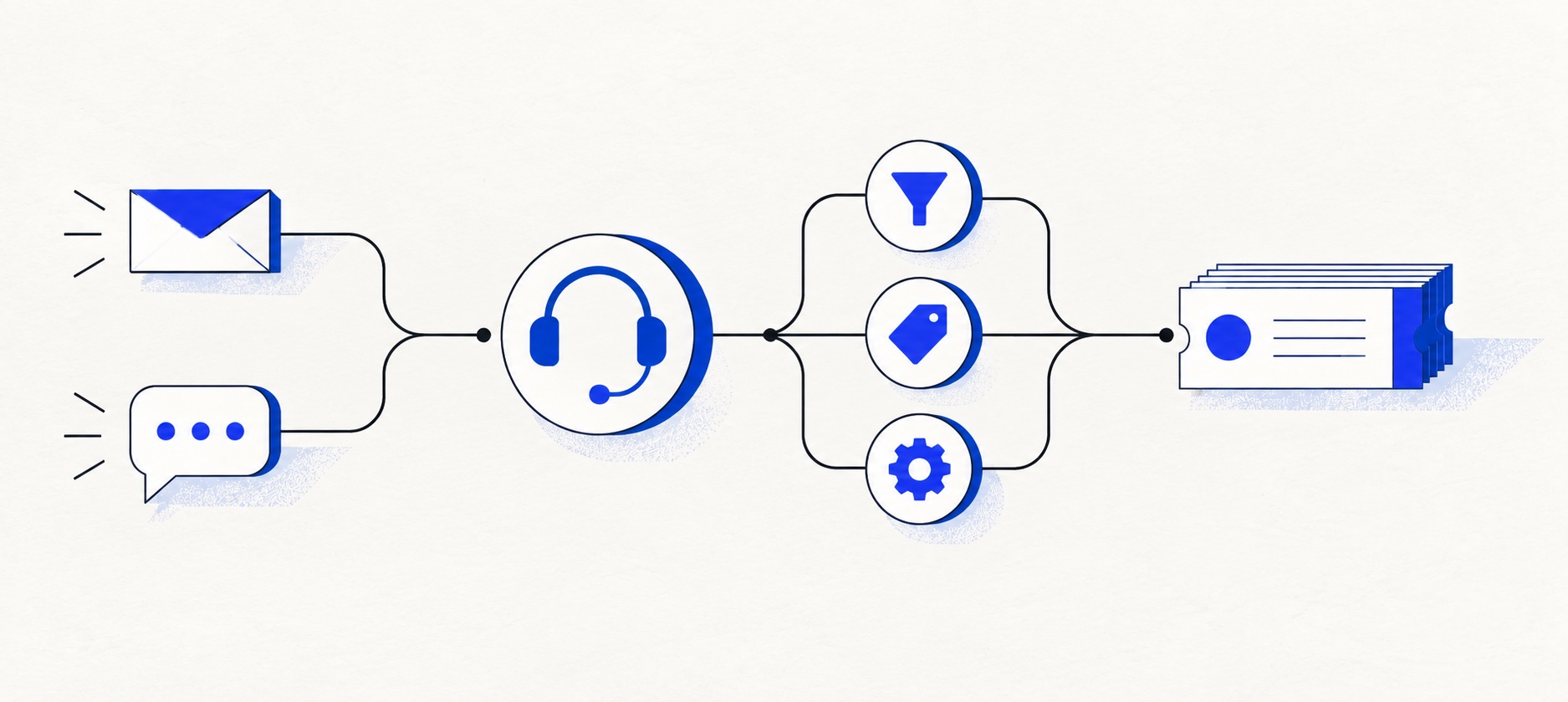
Essential combines the core queue, website chat and messaging channels for $19 per user each month on annual billing.
The interface and plan shape suit teams replacing shared email, rather than businesses seeking a broad CRM or enterprise service platform.
Check automation-rule, AI-resolution and reporting needs before committing, because those are likely upgrade or usage-cost triggers.
Product shortlist
HelpDesk at a glance
The card uses HelpDesk's official logo and links directly to the provider. It is an ordinary link while Support Sorted is not enrolled in the programme.

HelpDesk
Best for: Small teams that want ticketing, website chat and useful automation without an enterprise platform
A focused support workspace combining ticketing, a shared inbox, website chat, messaging channels, automation and reporting in one entry plan.
$19 per user/monthEssential, billed annually; checked September 2026
Useful strengths
- Ticketing, website chat and messaging channels on Essential
- 14-day trial without a credit card
Watch for
- There is no permanent free plan
- Extra AI resolutions can add usage cost
- 14-day trial
- Email, chat and messaging
- Per-user pricing
HelpDesk is one of the easier support products to understand. It takes the practical jobs that become unreliable in a shared mailbox—assigning an owner, preventing duplicate work, keeping private notes and finding earlier conversations—and puts them in a conventional ticket queue. It then adds website chat, simple messaging channels, automation and AI assistance without presenting itself as an all-purpose CRM.
Our verdict is positive for small, email-first support teams. HelpDesk Essential supplies enough structure to improve day-to-day ownership, and its $19 annual-billing price is competitive with other entry paid plans. The reservation is not the starting product; it is the cost and feature jump once a team needs more rules, deeper reporting or a larger AI allowance.
This review is based on HelpDesk's current pricing and help documentation.
HelpDesk pricing and plans
| Plan point | Published position | What it means for a small team |
|---|---|---|
| Essential | $19 per user/month annually; $25 monthly | A credible first paid tier for a small shared queue |
| Trial | 14 days, no credit card required | Useful for a controlled workflow test, not long parallel running |
| AI allowance | 10 AI resolutions each month on Essential | Model extra usage separately if automation is central to the case |
| Growth | $79 per user/month annually; $99 monthly | 10 ticketing rules and more reporting and team controls |
At annual billing, two users on Essential cost $38 a month before tax; five cost $95. That arithmetic is simple, but the useful budget is not always just seats. A team attracted by AI resolutions should estimate how many conversations could be completed without an agent and check the current allowance and overage price. It should also list the rules, reports and integrations it expects to need in twelve months.
The 14-day trial is sufficient if it is treated as a test rather than an open-ended exploration. Connect one support address, bring in a controlled sample of enquiries and give every tester a named workflow. Do not change the live customer address until exports, notifications and fallback access have been confirmed.
Our plan-selection analysis: count rules before seats
Consider an illustrative two-person support team, not a reported customer result. It needs email ownership, website chat and three separate ticketing rules: classify billing, flag urgent requests and route sales enquiries. Essential's published three-rule limit makes it a candidate. Adding a third colleague changes the seat bill; it does not, by itself, change that feature requirement.
Now add a fourth independent, mandatory rule for a separate escalation path. If it cannot be represented within three supported rules without losing the intended control, Essential no longer satisfies this scenario. Growth's ten-rule capacity becomes relevant. This is a feature boundary, not a claim that an extra rule automatically saves money or improves service.
| Scenario | Annual-billing calculation | 12-month base |
|---|---|---|
| 2 users, requirements fit Essential | 2 × $19 × 12 | $456 |
| 3 users, same Essential requirements | 3 × $19 × 12 | $684 |
| 2 users, Growth feature required | 2 × $79 × 12 | $1,896 |
| 5 users, requirements fit Essential | 5 × $19 × 12 | $1,140 |
| 5 users, Growth feature required | 5 × $79 × 12 | $4,740 |
For the two-person case, upgrading adds $1,440 a year, calculated as 2 × ($79 − $19) × 12. For five users, the same feature boundary adds $3,600. Our conclusion is therefore conditional: HelpDesk's attractive entry rate is a strong argument only while the operating requirements actually fit Essential.
What would justify that difference?
Use a decision ledger with four fields for each rule: trigger, required action, exception and consequence if handled manually. Distinguish a genuinely independent escalation from a label that could be applied by an agent. Do not merge unrelated controls merely to fit the cheaper tier, and do not buy Growth for hypothetical future rules that nobody owns.
As a sensitivity check, assume an illustrative $30 internal cost per productive hour, not a measured HelpDesk saving. The two-user $1,440 uplift corresponds to 48 hours a year, or four hours a month. That is a hurdle to examine against your own workload, not a forecast of time recovered. A security or service obligation may justify the upgrade without any time saving.
Where this recommendation changes
Essential remains the starting recommendation when the rule ledger fits its limit and the required reports are available. Growth enters the shortlist when a non-negotiable control falls outside that boundary. If a public customer help centre is essential, verify that specific function separately: an AI knowledge source is not evidence of a publishable help centre. Compare Freshdesk's included self-service before treating the higher HelpDesk tier as the answer.
Annual equivalents are not cancellable monthly prices. At the published monthly rates, two users would cost $600 on Essential or $2,376 on Growth across twelve unchanged monthly subscriptions. Tax, AI usage, third-party charges and internal setup work are excluded from all these totals. Carry those items into the total-cost calculator rather than interpreting this base comparison as a complete budget.
Ticketing and shared-inbox workflow
HelpDesk's strongest feature is coherence. Incoming conversations become tickets with visible status and ownership. Agents can leave private notes, use canned responses and search the customer history. That is the essential operational step up from a shared mailbox: everybody can see who is responsible and what has already happened.
Essential also includes automated assignment and three ticketing rules. Three rules can cover a surprisingly useful baseline—for example, tagging billing messages, prioritising an outage phrase and assigning sales enquiries—but a team with several products or escalation paths can reach the limit quickly. Count actual rules during the trial instead of describing the process as “simple”.
Website chat is valuable because a conversation can enter the same support workspace rather than living in a separate widget account. Messenger and SMS support broaden the available channels. The buying question is whether those are the channels customers genuinely use, and whether the team can staff them to the response expectation they create.
Automation and AI
HelpDesk provides automation at two levels. Conventional rules can tag, assign or otherwise process tickets when defined conditions are met. AI features can assist with replies and resolve eligible requests. The distinction matters: deterministic rules are predictable operating controls, whereas AI outcomes depend on the content, knowledge available and billing model.
Start with rules that remove obvious manual work. A good first set assigns ownership, identifies urgent language and labels a repeatable request category. Measure the number of correctly processed tickets and the exceptions. Only then should the team judge whether AI resolution creates enough additional value to justify usage beyond the included allowance.
AI should never hide a weak handover. Keep a visible route to a person, sample completed conversations and check whether the resolution is counted when the customer reopens the issue. Those questions influence both service quality and cost.
Reporting, organisation and administration
A small team generally needs fewer dashboards than it imagines. Queue volume, first response, resolution time, status, category and ownership are a sensible base. HelpDesk provides reporting within the product, but buyers should verify the measures and filters available on the intended plan. A chart called “response time” is not useful until the team knows whether business hours, reopened tickets and bot replies affect it.
Administration is where the contained product can be an advantage. A team can establish groups, views, tags and saved replies without designing an entire CRM data model. That makes HelpDesk approachable for an owner or operations manager who will administer support alongside another job.
The same simplicity can become a limitation for a mature operation. Businesses needing skill-based routing, several service policies, complex permissions or deeply customised analytics should compare the next plan with Freshdesk Pro and Zendesk Suite rather than assuming the entry experience scales unchanged.
Where HelpDesk falls short
There is no permanent free edition. A microbusiness that needs a no-cost queue for two or three people should look at Zoho Desk's free plan or HubSpot's free service tools, while accepting their own limits. HelpDesk is a paid-product decision after the trial.
The second weakness is the upgrade cliff. Essential is attractive because it bundles the main small-team functions, but requirements that fall outside it can make the next tier materially more expensive. This is why rule counting and a twelve-month headcount model matter.
Finally, HelpDesk is not the natural specialist for every context. HubSpot is stronger when support must live beside sales and marketing records. Gorgias is more purpose-built for Shopify order actions. Zendesk and Freshdesk offer broader routes into complex service operations. HelpDesk wins when focus is a benefit, not when breadth is the main requirement.
Who should choose HelpDesk?
Choose HelpDesk if three statements are true: most support begins in email or website chat; clear assignment and shared history would solve the current failure; and the team wants a contained support tool rather than a wider customer platform. It is especially sensible for a two-to-ten-person service team that values a quick administrative start.
Look elsewhere if a permanent free plan is essential, Shopify actions drive a large share of tickets, CRM context is the heart of every reply, or complex routing is already a firm requirement. Those are not marginal preferences; they point towards a different product category.
A practical HelpDesk trial plan
Use ten representative tickets: a new question, a repeat customer, an urgent complaint, an attachment, a chat handover, an issue needing an internal note, a duplicate message, a reassignment, a saved reply and a reopened case. Ask two people to process them without speaking to each other. The queue should make the correct next action obvious.
Then build the three most valuable rules, create a basic report, inspect mobile notifications and export ticket data. Record which tasks were easy, which required documentation and which demanded a different plan. The result is a buying decision grounded in the team's process rather than a feature tour.
Final verdict
HelpDesk is a strong focused help desk for small teams. Essential combines the right core ingredients at a reasonable entry price, and its contained scope can reduce training and administration. It is not the cheapest possible route because there is no free plan, and it is not automatically the best route for complex growth.
The best buyer is a team whose current pain is ownership, not platform integration. Test the exact number of rules, the reports that management will use and the likely AI volume. If Essential covers those requirements, HelpDesk is one of the clearest upgrades from shared email.
Sources
All plan facts come from provider sources. Product-fit conclusions are Support Sorted's editorial judgement.
Frequently asked questions
Questions readers ask before choosing
Is HelpDesk suitable for a small business?
Yes. HelpDesk is particularly suitable for a small email-led team that needs assignment, history, saved replies, basic automation and website chat without adopting a large service suite. Teams with complex routing or several brands should test the higher plans carefully.
Does HelpDesk have a free plan?
No permanent free plan is advertised. HelpDesk offers a 14-day trial without requiring a credit card, which is long enough to test a representative queue if the team prepares its trial tasks in advance.
How much does HelpDesk cost?
Essential is advertised at $19 per user each month when billed annually, or $25 on monthly billing. Prices were checked in September 2026 and exclude applicable tax. Higher plans and extra AI usage increase the cost.
Is HelpDesk the same as LiveChat?
No. HelpDesk is the ticketing and shared-inbox product, although it includes website chat capabilities and sits in the same product family as LiveChat. Check which product and integration a quoted feature requires before purchasing.
When is HelpDesk Growth worth the upgrade?
Growth is worth considering when an essential workflow exceeds Essential's three ticketing rules or requires Growth reporting and team controls. For two users on annual billing, the base rises from $456 to $1,896 a year before tax and extras. More users alone do not establish a need for the higher tier.