
Growing team buying guide
Customer-support software for five-person teams
Compare support tools for a five-person team, with practical advice on queues, reporting, knowledge, permissions and the real cost of five agents.
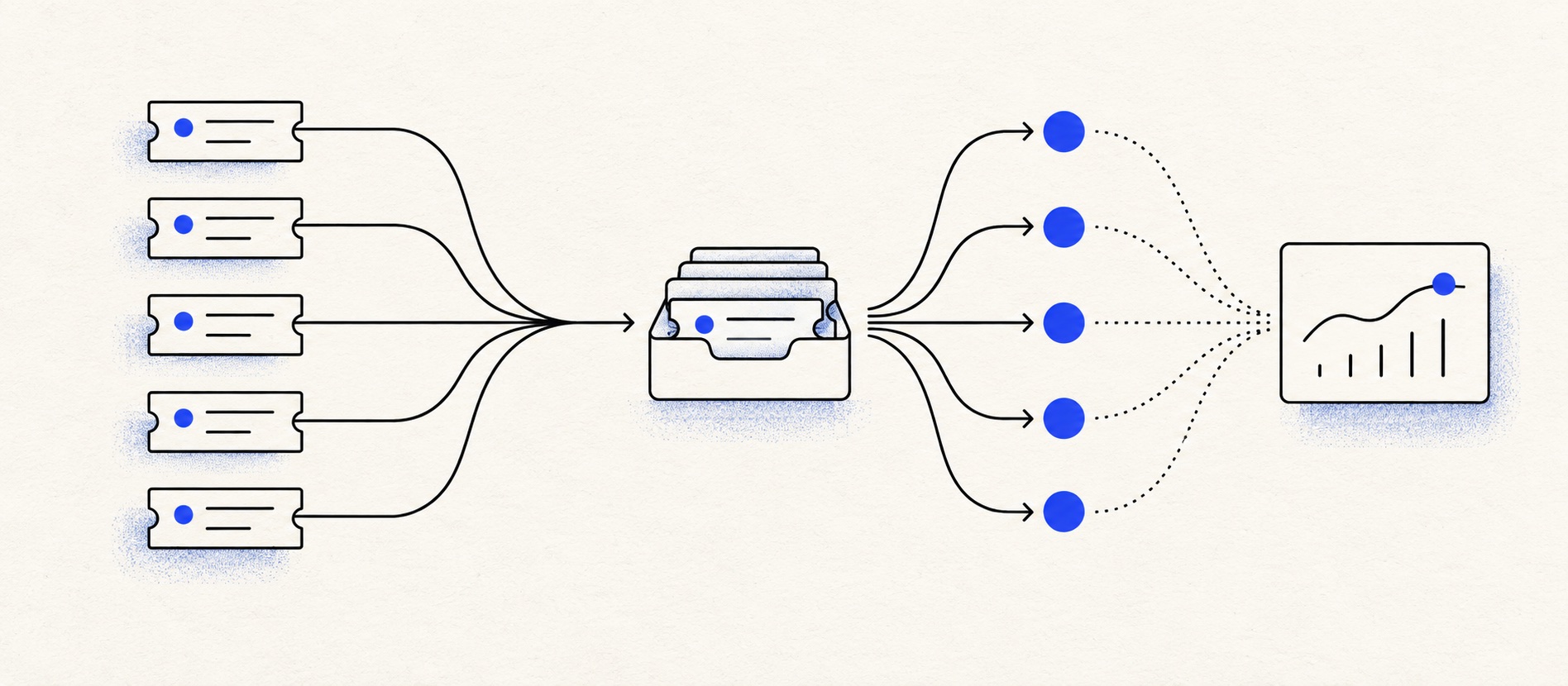
Define queue ownership, escalation and knowledge maintenance before comparing automation menus.
Price five active agents on the plan that includes your required reporting, policies and channels.
Test temporary cover and a sixth user; the next hiring decision should not require a rebuild.
Product shortlist
Six products to assess for five support users
Recognisable provider logos sit beside each product.

Freshdesk
Best for: Growing teams that need proper ticketing, self-service, automation and reporting
A broad email-first help desk with ticketing, a shared inbox, a customer portal, knowledge base and out-of-the-box reporting on its entry paid plan.
$19 per agent/monthGrowth, billed annually; checked September 2026
Useful strengths
- Ticketing, shared inbox and knowledge base on Growth
- Clearer route into routing, SLAs and custom reporting
Watch for
- Omnichannel needs differ from the email-first Freshdesk plan
- AI and connector usage can add cost
- Free trial
- Email-first help desk
- Per-agent pricing

HelpDesk
Best for: Small teams that want ticketing, website chat and useful automation without an enterprise platform
A focused support workspace combining ticketing, a shared inbox, website chat, messaging channels, automation and reporting in one entry plan.
$19 per user/monthEssential, billed annually; checked September 2026
Useful strengths
- Ticketing, website chat and messaging channels on Essential
- 14-day trial without a credit card
Watch for
- There is no permanent free plan
- Extra AI resolutions can add usage cost
- 14-day trial
- Email, chat and messaging
- Per-user pricing

Zendesk
Best for: Teams that expect multiple channels, mature routing and increasing operational complexity
The Support Team plan supplies core email ticketing, routing, analytics and automations. The broader Suite adds live chat, messaging, telephony and a knowledge base.
£15 per agent/monthSupport Team, paid yearly; checked September 2026
Useful strengths
- GBP pricing and a clear entry ticketing plan
- Strong upgrade path for multichannel operations
Watch for
- Suite Team rises to £45 per agent/month
- Small teams may buy more process than they need
- 14-day trial
- GBP pricing available
- Per-agent pricing

Zoho Desk
Best for: Budget-conscious teams and businesses already using the Zoho ecosystem
The free edition covers three users and email ticketing. Paid tiers add broader messaging, knowledge-base, reporting, automation and telephony capabilities in stages.
Free for 3 usersPaid plans vary by selected billing currency; checked September 2026
Useful strengths
- Three-user free edition
- Broad channel and Zoho integration range
Watch for
- Plan and currency selectors make budgeting less immediate
- Live chat and advanced routing are plan-dependent
- 15-day trial
- Free edition
- Three users on free plan

HubSpot Service Hub
Best for: Businesses that want support, sales and marketing activity on one customer record
Free tools cover basic ticketing, inbox and live chat. The dedicated advanced help-desk workspace, knowledge base, SLAs and deeper routing are concentrated in Professional and Enterprise.
Free for up to 2 usersProfessional from $90/seat/month annually plus onboarding; checked September 2026
Useful strengths
- Support history beside CRM, sales and marketing data
- Free entry tools and a large integration marketplace
Watch for
- Advanced help desk features require a large price jump
- Professional has mandatory onboarding cost
- 14-day trial
- CRM-connected service
- Two users on free tools

Gorgias
Best for: Online shops that need order context and ecommerce actions inside support conversations
Unlike per-seat tools, Gorgias prices its help desk by billable ticket volume. Its strongest case is the depth of its Shopify and ecommerce workflow integrations.
$10/month for 50 ticketsStarter includes 3 agent seats; checked September 2026
Useful strengths
- Deep Shopify order context and actions
- Costs scale by tickets rather than only by agent seats
Watch for
- Overages and AI resolutions need modelling
- Entry plan is email-only and has limited operations features
- 7-day trial
- Shopify-focused
- Ticket-volume pricing
A five-person support team is large enough for hidden work to become expensive. One person may answer email while another handles chat; a third knows billing; two more cover peaks. Without an agreed queue, tickets bounce between people and nobody can tell whether a promise was kept.
The best customer-support software for five people should make work visible without imposing an enterprise process. Compare products against one realistic week: new requests, old cases, absences, repeated questions and a customer who changes channel. The winning tool should help the team work consistently today and add a sixth person without redesigning everything.
Quick comparison
| Product | Five-person use | Pricing basis | Watchpoint |
|---|---|---|---|
| Freshdesk | Email queue, knowledge and standard reporting | Per agent | Pro for more advanced policies |
| HelpDesk | Focused support operation | Per user | Essential rule allowance |
| Zendesk | Multiple queues and future channel depth | Per agent | Support and Suite are different buys |
| Zoho Desk | Value-led paid scaling | Per user above free limit | Three-user free cap |
| HubSpot Service Hub | Support tied to a shared CRM | Seats and edition | Advanced workspace tier |
| Gorgias | Retail order workflows | Billable ticket volume | Peak months and AI outcomes |
Five paid Freshdesk Growth seats have a $95 monthly reference on annual billing; five HelpDesk Essential seats have the same reference. Those products deliver different workflows. The comparison must include the feature tier that actually covers your policies, reporting and channels.
Design the queues before the trial
Start with one customer-facing intake route and a small number of reasons for contact. Separate a specialist queue only when it has a named owner and enough work to justify it. A useful first split may be general enquiries, billing and technical issues. Too many queues can make five people spend more time routing than resolving.
Every ticket needs one primary owner. Specialists can contribute through notes or linked work without taking away responsibility for the customer update. Define an escalation that states when it happens, who receives it and who remains accountable for the reply. Test a case that crosses two functions, such as a refund needing finance approval.
Keep statuses few and observable: new, in progress, waiting for customer, waiting internally and resolved may be enough. Agree whether reopening a resolved case returns to the same owner. These decisions matter more than an elaborate dashboard at the start.
Freshdesk: the balanced five-agent starting point
Freshdesk Growth combines email ticketing, shared inbox work, a customer portal, knowledge base and standard reporting. That breadth makes it a credible default when a five-person team has enough repeated questions to maintain self-service and enough volume to review performance weekly.
Its $19 per-agent monthly annual reference is easy to model for a stable team. The main question is whether Growth contains the real workflow. Freshdesk Pro adds more developed routing, multiple service policies and custom reports at a higher per-agent rate. A team supporting several contractual customer groups may need Pro much sooner than one handling ordinary retail questions.
In a trial, create one useful help article, one escalation and a weekly report. Ask an agent to find and reuse the answer without administration help. The strength of Freshdesk is operational range; the risk is paying for that range without maintaining it.
HelpDesk: keep a focused operation focused
HelpDesk Essential is also listed at $19 per user monthly on annual billing. It offers a contained ticket workspace with chat and practical collaboration. For a five-person company where support is shared among people with other roles, a smaller operational surface can be an advantage.
Test whether the team can identify ageing tickets, add private context, use saved replies and hand work over cleanly. Write every desired automation rule on paper first. Essential's rule limit can be reached when separate billing, urgency, language and product routes are all required.
HelpDesk is strongest when the core problem is ownership of a compact queue. If the buying brief already includes several brands, distinct service policies and custom dashboards, compare a broader system before settling on the entry tier.
Zendesk and Zoho Desk: different scaling paths
Zendesk's UK Support Team plan is an email-ticketing entry point, while its Suite adds broader channels and self-service. It suits a team expecting more formal service operations, but the plan names must not be treated as equivalent. Price the Suite when chat, messaging or a help centre belongs in the brief.
Zoho Desk's free edition stops at three users. A five-person team needs a paid edition if all five will be agents. Zoho can still provide value, especially if customer information already lives in Zoho applications. Check the current Express, Standard and higher editions against the exact channels, automation and reporting required.
Both can be good choices. Zendesk asks whether the team will use its service-platform depth; Zoho asks whether the edition that covers five agents and their workflow remains the best total value. Do not compare a three-user free tier with a five-user paid plan as though they cover the same team.
HubSpot and Gorgias: choose the context
HubSpot Service Hub is a candidate when support, sales and account management need one customer record. If agents regularly ask a colleague for contract, onboarding or purchase context, connected CRM data may shorten work. Its advanced help desk workspace sits in paid tiers, so test the actual edition you would purchase.
Gorgias is a different economics and workflow choice. It charges primarily by billable ticket volume and is strongest when an online store needs order information and supported actions beside the conversation. Five agents handling a modest number of high-value retail enquiries might find a volume model attractive; a seasonal spike can reverse that calculation.
Neither product is a general default for five people. HubSpot should earn its cost through a useful shared CRM; Gorgias through store operations and a defensible peak-volume forecast.
Reporting that changes decisions
At five people, a manager needs to see unresolved count, ticket age, first response, reopening and reasons for contact. Define business hours before setting targets. Count how many cases wait on the customer or another department so the team is not judged for time it cannot control.
Use categories to find fixable causes. A rising number of delivery queries may call for better tracking notifications; repeated product setup questions may call for a guide. Agent-level counts are a poor substitute for complexity, quality and customer outcome.
Recreate one weekly report from raw tickets during the trial. If supervisors cannot explain why the dashboard total differs from the queue total, resolve that before purchasing. Trustworthy definitions beat decorative charts.
Knowledge, permissions and cover
Assign one owner to each public help article and review it after a policy change. Keep internal procedures separate from customer-facing content. A five-person team benefits from a small maintained library of answers, not hundreds of stale pages.
Use individual logins, roles and restricted access where the plan supports them. Test what a new joiner can see and whether a departing person can be disabled without losing the history. For sensitive billing or account cases, confirm whether the chosen tier supports the visibility rules you need.
Run a holiday-cover exercise. Remove one agent from the rota and ask the remaining four to identify that person's open promises. If the system cannot make those visible, the handover process needs repair before a new channel is added.
Trial scorecard and cost model
Give each candidate the same ten cases: simple request, repeat customer, urgent escalation, knowledge answer, channel switch, reopened case, billing exception and case waiting on another team. Time the work, record context switches and note any feature that unexpectedly requires a higher plan.
Budget for five active users, one future user and temporary cover. Add onboarding, integrations, AI usage, messaging or voice, annual commitment and tax. For Gorgias, model quiet, normal and peak ticket months separately. The cheapest first invoice is not the same as the cheapest working operation.
Final recommendation
Choose Freshdesk for a balanced ticket, knowledge and reporting operation; HelpDesk for a focused queue; Zendesk for anticipated service-platform depth; Zoho Desk for value-led scaling; HubSpot for CRM-connected service; or Gorgias for an online retail team that uses order context every day.
The deciding evidence is whether five people can see ownership, pick up one another's work and report on the queue consistently. Test those tasks before committing to an annual contract.
Sources
- Freshdesk pricing
- Freshdesk collaboration
- HelpDesk pricing
- Zendesk UK pricing
- Zoho Desk pricing
- HubSpot Service Hub
- Gorgias pricing
Plan facts come from provider sources. Product-fit conclusions are Support Sorted's editorial judgement.
Frequently asked questions
Questions readers ask before choosing
What changes when a support team reaches five people?
Informal handovers become less reliable. The team usually needs named ownership, shared statuses, a documented escalation path, a maintained knowledge source and weekly reporting that distinguishes volume from difficult work.
Is a five-person team too small for Zendesk?
No, but compare the exact Support and Suite plans. Zendesk makes most sense when channel breadth, service policies or future complexity justify its setup and higher-tier cost.
How much does support software cost for five agents?
Multiply the applicable per-agent plan by five and include billing term, VAT, add-ons and the first upgrade you need. Volume-based products such as Gorgias require normal and peak ticket counts instead.
Should all five agents work every channel?
Usually not by default. Assign clear channel ownership and cover, then use one shared customer history. Launch a new channel only when staffing can meet the response expectation it creates.