
Head-to-head comparison
Gorgias vs Zendesk
Compare Gorgias and Zendesk on Shopify workflows, ticket and agent pricing, channels, routing, AI and fit for ecommerce support teams.
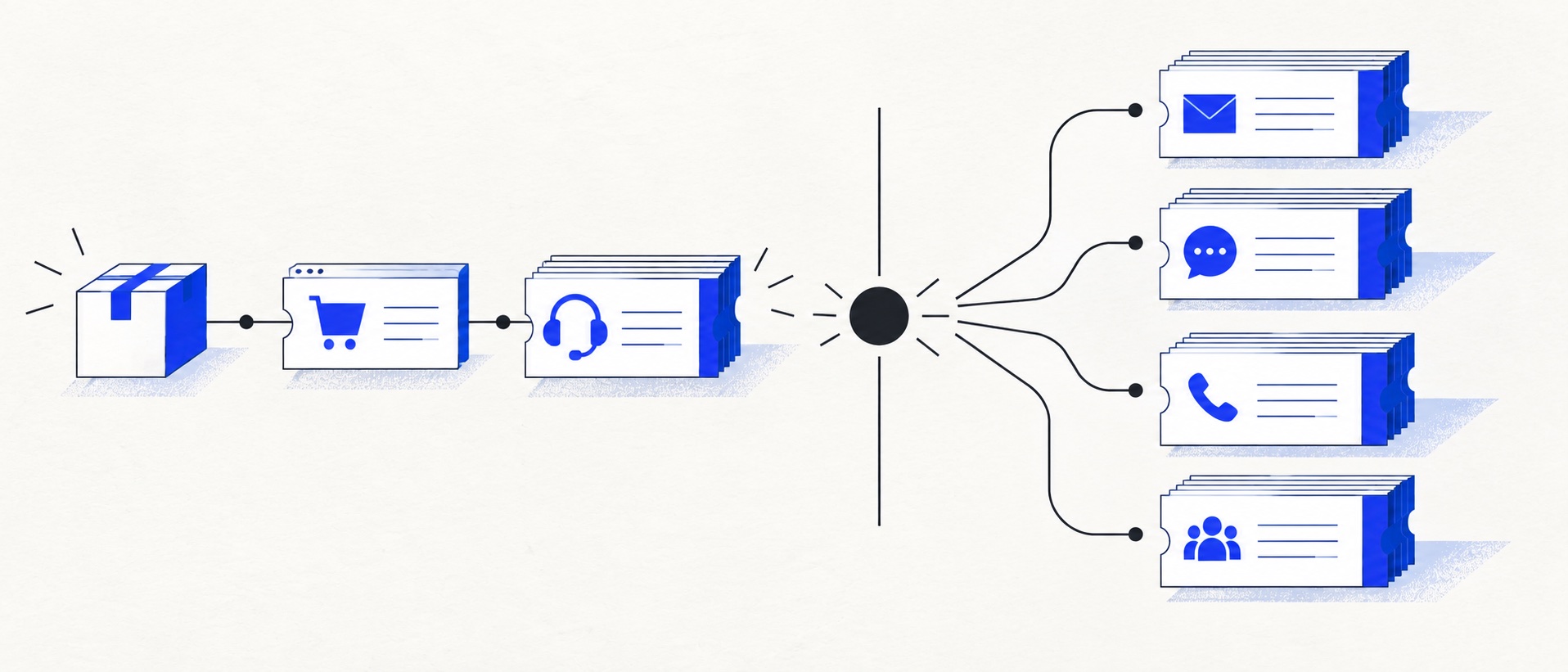
Gorgias scales primarily by billable ticket volume; Zendesk prices mainly by agent and selected Support or Suite tier.
Shopify actions make Gorgias the more direct store-operations tool, while Zendesk offers broader general-service depth.
Model a normal month and seasonal peak, including AI, channels, overages and temporary agents.
Product shortlist
Gorgias and Zendesk side by side
One route is commerce-native; the other is a broad support platform. Compare equivalent channel coverage.

Gorgias
Best for: Online shops that need order context and ecommerce actions inside support conversations
Unlike per-seat tools, Gorgias prices its help desk by billable ticket volume. Its strongest case is the depth of its Shopify and ecommerce workflow integrations.
$10/month for 50 ticketsStarter includes 3 agent seats; checked September 2026
Useful strengths
- Deep Shopify order context and actions
- Costs scale by tickets rather than only by agent seats
Watch for
- Overages and AI resolutions need modelling
- Entry plan is email-only and has limited operations features
- 7-day trial
- Shopify-focused
- Ticket-volume pricing

Zendesk
Best for: Teams that expect multiple channels, mature routing and increasing operational complexity
The Support Team plan supplies core email ticketing, routing, analytics and automations. The broader Suite adds live chat, messaging, telephony and a knowledge base.
£15 per agent/monthSupport Team, paid yearly; checked September 2026
Useful strengths
- GBP pricing and a clear entry ticketing plan
- Strong upgrade path for multichannel operations
Watch for
- Suite Team rises to £45 per agent/month
- Small teams may buy more process than they need
- 14-day trial
- GBP pricing available
- Per-agent pricing
Gorgias and Zendesk can both support an online retailer, but they start from different operating assumptions. Gorgias treats ecommerce context and order actions as the centre of support. Zendesk provides a general service platform that can be connected to commerce while also serving B2B, SaaS and other customer-operation models.
Our verdict is straightforward: Gorgias is better for a Shopify-led team whose agents act on orders; Zendesk is better for a complex general service operation. Pricing does not produce a universal winner because Gorgias counts billable tickets and Zendesk mainly counts licensed agents.
Quick comparison
| Area | Gorgias | Zendesk |
|---|---|---|
| Starting point | $10/month, 50 tickets, 3 users | £15/agent/month annually, Support Team |
| Broader plan | Basic $60/300 tickets; Pro $360/2,000 | Suite Team £45/agent/month annually |
| Distinctive strength | Shopify context and order actions | General multichannel routing and service controls |
| Billing risk | Peak tickets, overages and AI outcomes | Agent growth, Suite tier and add-ons |
| Best fit | Ecommerce support operation | Cross-industry service organisation |
Published currencies are retained rather than converted at a temporary exchange rate. Figures exclude applicable tax and optional services.
Ecommerce context and Shopify work
Gorgias wins the most important ecommerce category. Its Shopify integration exposes relevant customer and order data in the workspace and supports actions such as refunds and cancellations. An agent can resolve a common request without repeatedly searching the commerce admin.
Zendesk can connect with ecommerce systems through integrations, and its flexibility may suit a retailer already operating a complex service stack. But an integration listing does not guarantee equivalent depth. The buyer should test the exact order fields, multi-store identity and actions needed.
Measure this category with work, not screenshots. Time order tracking, a pre-fulfilment cancellation, a return and a partial refund. Check permissions and unusual histories. If Gorgias removes several steps from the most common tickets, that advantage can outweigh a subscription difference.
Ticketing and agent experience
Both platforms create owned tickets, internal collaboration and customer history. Gorgias shapes the experience around ecommerce categories and actions. Zendesk provides a more general system of views, groups, forms, fields, triggers and automations.
For store support, Gorgias can feel more direct because the business context is already present. For a company supporting several products, contracts or technical escalation paths, Zendesk's flexible service model is more adaptable.
The best agent experience makes the next safe action obvious. Give new testers an ambiguous multi-order customer, a duplicate message and an escalation. Observe whether they find context and ownership without asking an administrator.
Channels and real-time support
Gorgias centralises ecommerce conversations across plan-dependent channels, but Starter is deliberately limited and email-focused. Social, voice and SMS requirements must be priced on the correct tier or add-on. Ecommerce teams should test identity matching when the same shopper uses email and social messaging.
Zendesk Support Team is primarily the email ticketing starting point. Suite Team adds messaging, live chat, telephony, knowledge and omnichannel routing. Zendesk has the stronger broad-channel proposition for an organisation that needs managed distribution across several contact types.
Gorgias remains stronger when each channel should lead quickly to store action. Zendesk wins when the channel itself, capacity management and cross-department routing are the main operating challenge.
Automation and AI
Gorgias automation and AI Agent are designed for repeated commerce interactions such as order status and policy questions. Automated resolutions carry an outcome-based fee under the current model. The business should monitor repeat contact, escalation and customer effect as well as the number of completed interactions.
Zendesk supplies rules, triggers and automation across its ticketing platform, with AI capabilities available in its broader commercial proposition. It offers more general flexibility for categorisation, assignment and service workflows, but inclusions and add-ons need a precise quote.
In both products, begin with predictable work. Keep a person-access route, sample outcomes and define what counts as resolved. Gorgias has the ecommerce-specialist advantage; Zendesk has the flexible general-operations advantage.
Routing and team structure
Zendesk Suite's omnichannel routing can distribute work based on availability and capacity. That is useful for specialist groups, shifts and a mix of synchronous and asynchronous channels. Larger service organisations are likely to value its routing model.
Gorgias supports ecommerce team collaboration, and volume-based plans may accommodate many people more naturally than a strict per-agent bill. However, plan allowances and available controls must match the store's actual organisation. A large seasonal team does not automatically make Gorgias cheaper if ticket volume also surges.
For two or three generalists, simple ownership may beat either product's sophisticated routing. For several queues and skills, run absence, overload and escalation scenarios before selecting a winner.
Reporting and business insight
Gorgias can turn support categories into ecommerce insight. Contacts about delivery, sizing, product quality or returns can inform operations and merchandising. This is valuable when integrations and tagging produce data the wider retail team will actually use.
Zendesk offers a mature route into service analytics across channels and groups. It is stronger when management needs a general operating view spanning customer types, products or departments rather than store-only performance.
Define the desired decision first. “Which courier caused the rise in contacts?” favours ecommerce-linked context. “Which specialist group misses the response target across chat and email?” favours mature service reporting. Confirm metric definitions in either system.
Cost model: volume versus agents
Gorgias Starter is $10 for 50 tickets and three users, Basic $60 for 300, Pro $360 for 2,000 and Advanced $900 for 5,000. The current billing model generally counts a help-desk ticket when at least one message is sent from Gorgias. Fully automated AI resolutions can be charged separately.
Zendesk Support Team is £15 per agent each month annually, Suite Team £45 and Suite Professional £89. Five Suite Team agents cost £225 a month before tax; ten cost £450. Add relevant AI or operational packages.
Model three cases: a normal month, the promotion peak and the post-peak returns period. Include temporary staff, ticket overages, AI outcomes, voice and SMS. Gorgias tends to benefit a collaborative team with manageable volume; Zendesk becomes more predictable when agent count and Suite scope are stable.
Administration and governance
Gorgias implementation should focus on store connections, permissions, macros, tags, automation and billing alerts. Access to refunds and cancellations must follow role and value limits. Somebody should monitor volume during campaigns and delivery incidents.
Zendesk implementation requires decisions about groups, forms, fields, views, triggers, channels and reporting. Its greater general flexibility creates a larger governance job. A defined administrator and change log are sensible even for a modest team.
Both products should be launched in stages. Preserve the old ticket history, test export, document escalation and train agents on the intended workflow rather than every available feature.
Which should you choose?
Choose Gorgias when Shopify is the operational centre, agents frequently take order action, ecommerce automation is valuable and ticket-volume economics remain acceptable through the busiest month. It is the specialist recommendation.
Choose Zendesk when the organisation supports more than retail transactions, needs mature omnichannel routing, has specialist groups or wants a general service platform that can serve several business models. Treat Suite as the relevant plan when knowledge and live channels are required.
A small store with low volume should also compare HelpDesk. A growing email-first team may prefer Freshdesk. HubSpot is worth considering when service needs a shared CRM view across sales and marketing.
Trial checklist
Use identical ecommerce cases in both products: tracking, cancellation, return, refund, product advice, social contact and a duplicate enquiry. Connect the real store or safe test environment. Confirm context, permitted action, handover and reporting.
Then test a busy-agent route, an after-hours message, data export and one automation. Price the observed normal volume and a realistic peak. The winning product should reduce customer-handling work while keeping permissions, cost and management visible.
Final verdict
Gorgias wins when support is inseparable from Shopify operations. Its integrated context and actions can make everyday ecommerce work materially faster, and its volume model can suit a team with many collaborators.
Zendesk wins when the business needs a broader service architecture with mature channels, routing and administration. The choice is less about which brand has more features than whether the queue is fundamentally a store-operation workflow or a general customer-service function.
Sources
- Gorgias pricing and plans
- Gorgias billing documentation
- Gorgias Shopify integration guide
- Zendesk UK pricing
- Zendesk omnichannel routing overview
All plan facts come from provider sources. Product-fit conclusions are Support Sorted's editorial judgement.
Frequently asked questions
Questions readers ask before choosing
Is Gorgias better than Zendesk for Shopify?
Usually, when agents need Shopify order context and supported actions such as refunds or cancellations inside the help desk. Zendesk can support ecommerce through integrations, but Gorgias is designed around the store workflow.
Is Zendesk cheaper than Gorgias?
The billing models are different. Zendesk starts at £15 per agent each month annually for Support Team, while Gorgias starts at $10 for 50 tickets and three users. Team size, ticket volume, Suite requirements, overages and AI determine the real result.
Which is better for a large support team?
Zendesk is stronger for a large general service organisation needing mature routing and specialist roles. Gorgias can be attractive for a large ecommerce team because higher plans are not shaped only by agent seats, but ticket volume must be forecast carefully.
Can Gorgias replace Zendesk?
Yes for many ecommerce teams, if its channels, reporting, permissions and ticket allowances cover the operation. It is less natural as a replacement for a complex B2B, SaaS or non-retail service desk.