
Product review
Gorgias review
Our Gorgias review examines Shopify support features, ticket-volume pricing, AI costs, channel limits and its fit for UK ecommerce teams.
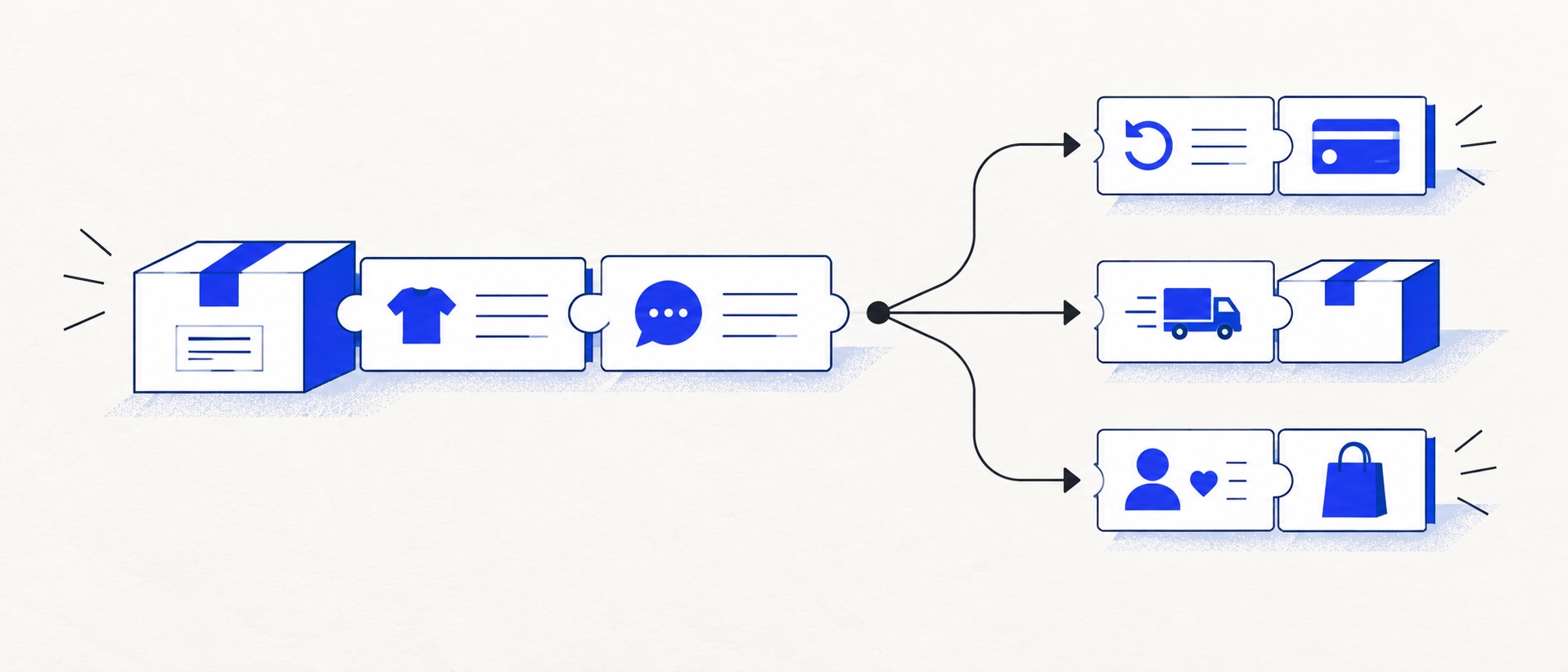
Shopify order context and supported actions make Gorgias operationally different from a general help desk.
Starter begins at $10 for 50 tickets and three users; larger tiers scale mainly by billable ticket volume.
Forecast the busiest month, not only the annual average, and keep help-desk ticket charges separate from AI-resolution charges.
Product shortlist
Gorgias at a glance
The Gorgias wordmark identifies the reviewed product.

Gorgias
Best for: Online shops that need order context and ecommerce actions inside support conversations
Unlike per-seat tools, Gorgias prices its help desk by billable ticket volume. Its strongest case is the depth of its Shopify and ecommerce workflow integrations.
$10/month for 50 ticketsStarter includes 3 agent seats; checked September 2026
Useful strengths
- Deep Shopify order context and actions
- Costs scale by tickets rather than only by agent seats
Watch for
- Overages and AI resolutions need modelling
- Entry plan is email-only and has limited operations features
- 7-day trial
- Shopify-focused
- Ticket-volume pricing
Gorgias is not simply another ticketing system with a Shopify logo in its integration directory. Its case is operational: an agent can see relevant ecommerce context and perform supported order actions while handling the customer conversation. For a busy store, reducing tab switching and copying can be more valuable than a lower nominal seat price.
Our verdict is that Gorgias is the best specialist choice for Shopify-led customer support, provided the store understands its volume economics. Pricing scales primarily with billable tickets rather than agent seats, while AI resolutions use a separate outcome charge. This can suit a collaborative ecommerce team but makes seasonal forecasting essential.
This review is based on Gorgias pricing, billing and integration documentation.
Gorgias pricing and ticket allowances
| Plan | Published starting price | Included help-desk volume |
|---|---|---|
| Starter | $10/month | 50 tickets and 3 user seats |
| Basic | $60/month | 300 tickets |
| Pro | $360/month | 2,000 tickets |
| Advanced | $900/month | 5,000 tickets |
The table cannot be compared directly with per-agent tools. A store with ten people occasionally helping customers may benefit from volume-based pricing, while a two-agent store with heavy order traffic may move through allowances quickly. Calculate both people and conversations for every shortlisted product.
Gorgias explains that a help-desk ticket is counted when at least one message is sent from the help desk under the current model. AI Agent resolutions introduce an additional fee when an interaction is fully resolved automatically. Legacy contracts may differ, so businesses with an older account should use their own billing terms rather than a current public review.
Our peak-month analysis: distinguish volume from eligibility
An illustrative small Shopify team needs email, website chat and a customer help centre. Starter's email-only scope does not satisfy that brief even if the store has fewer than 50 tickets. Basic is the tier to examine first for those documented feature categories. Before calculating a five-person Basic budget, however, resolve a source inconsistency: the provider's plan guide lists 500 users in its table but three agent seats in its Basic prose. We leave that eligibility question open rather than selecting the more convenient number. Gorgias' plan guide contains both statements.
For a configuration confirmed eligible for the billing guide's $60 / 300-ticket / $0.40-extra-ticket example, the monthly help-desk line is $60 + $0.40 × max(0, billable tickets − 300). This is a calculation using a provider example, not a guarantee that every current or legacy Basic contract has those terms. The quantities below are fictional demand cases.
| Illustrative billable tickets | Tickets above allowance | Overage calculation | Modelled help-desk charge |
|---|---|---|---|
| 300 | 0 | 0 × $0.40 | $60 |
| 301 | 1 | 1 × $0.40 | $60.40 |
| 800 | 500 | 500 × $0.40 | $260 |
Now assume eleven months at 300 billable tickets and one at 800. The twelve-month projection is 11 × $60 + $260 = $920. This projects twelve monthly subscriptions at unchanged terms, not an annual-plan quote or discount. Unused monthly capacity cannot be treated as a portable annual allowance in this model: a different demand distribution can change the relationship between average volume and the bill.
For example, eleven months at 200 and one at 800 give the same $920 under this formula, despite a lower annual average of 250 tickets. Applying the 250-ticket average to every month would wrongly predict $720 and miss $200 of peak overage. This is why our recommendation depends on a monthly demand profile, not only annual tickets divided by twelve.
Why a lower arithmetic total does not settle the plan
The $260 peak example is below the published $360 Pro headline. That does not establish Basic as the correct purchase. Pro may supply a required feature or eligible user configuration; Basic's applicable overage terms still need verification. We have not applied Basic's $0.40 rate to Starter or Pro, and have not derived an exact upgrade threshold from prices that may have different billing or discount conditions.
The billing help centre defines the relevant ticket event as a ticket with a message sent from the help desk, including an AI or Rule reply. An incoming unanswered contact is therefore not the same unit as a billable ticket. Use that operational definition rather than the looser “viewed or responded to” wording in the marketing plan guide. AI outcome charges remain a separate line; subtracting automated contacts from ticket volume without checking both definitions can understate spend. The billing guide anchors our formula and event definition.
When we would change the recommendation
Gorgias remains a specialist candidate when order context and supported store actions are central to recurring work. Our conclusion weakens when a general B2B queue needs little ecommerce context, or when required user access and peak charges cannot be established from the applicable terms. Compare Freshdesk or Zendesk at the same peak staffing level, not their one-agent headline.
Before choosing a tier, record monthly billable counts, users, required channels, tier-specific overage and separate AI events. The ticket-volume forecast worksheet helps create the demand profile; the per-agent versus per-ticket guide explains how to compare it with a seat-based budget. Neither assumes measured time saved by Shopify integration.
Shopify context and order actions
The Shopify integration is the clearest reason to shortlist Gorgias. Agents can view customer and order information in the support workspace and perform supported actions such as refunds or cancellations. That changes the workflow from “read, open Shopify, find the order, act, return and reply” to a more contained process.
The value should be measured. During a trial, time ten common requests with and without the integrated action. Note errors avoided, not just seconds saved. Confirm permissions so a new agent cannot issue a high-value refund merely because the action is convenient.
Stores should also test multiple orders, partial fulfilment, returns and customers using a different email address. The easy demonstration is a clean one-order history; the valuable test is the ambiguous case that normally sends an agent searching.
Channels and ticket workflow
Gorgias centralises ecommerce support conversations, with plan-specific access to channels and operational features. Starter is deliberately constrained and described as email-focused. Social, messaging, voice and SMS requirements should be mapped to the current tier and any add-on before the store assumes they belong in the $10 price.
Inside the help desk, tickets need owners, tags, status and clear views like any other support platform. Ecommerce teams often benefit from categories tied to operational demand: delivery, return, damaged item, product advice and cancellation. Use tags that can influence stock, logistics or website improvements, not a long list that only decorates reports.
Peak conditions matter. Test how agents find urgent cancellations among routine order-status questions, how a social conversation becomes a trackable case and what happens when the shopper contacts the store twice. The system should preserve one understandable history without hiding an immediate request.
Automation and AI Agent
Automation can identify intent, apply rules and remove repetitive work. Gorgias AI Agent goes further by resolving eligible ecommerce interactions. This is attractive for order tracking and common policy questions, but the fee model and customer experience need separate evaluation.
First identify contacts that are genuinely predictable. Give the AI access only to accurate policy and store data, define when it hands over, and sample completed conversations. A resolution rate is not enough: monitor repeat contact, refunds, escalation and customer sentiment around automated outcomes.
Keep help-desk ticket allowances and AI-resolution fees in different budget lines. A store can reduce human handling while still paying for the automated result. That may be good value, but it should be visible. Ask Gorgias to confirm what happens when an AI-handled conversation later needs a person.
Reporting and ecommerce insight
Support reporting should help the store improve operations. Ticket volume and response time matter, but the more valuable questions often concern products, fulfilment partners, return reasons and recurring pre-purchase uncertainty. Design tags and integrations so those patterns can be investigated.
Gorgias' ecommerce position can make the support desk a useful source of trading insight. If one product generates repeated fit questions or one courier drives “where is my order” contacts, the answer may lie outside support. Share a concise weekly trend with merchandising and operations.
Metric definitions still matter. Confirm how automated responses, merged tickets and reopened contacts affect reported performance and billable volume. During migration, do not compare Gorgias numbers with an old mailbox as though both systems measured the same event.
Seasonal budgeting
An average month is a poor basis for ecommerce software. Use at least three volume cases: normal trading, a promotion and the busiest seasonal period. Include legitimate tickets, campaign-driven questions, delivery disruption and returns after the peak.
Calculate the cost of moving to the next allowance or paying overage, plus any voice, SMS and AI usage. Then compare that with agent-seat alternatives at the staffing level required during the same peak. Volume pricing can be favourable, but only a scenario model reveals it.
The same exercise should influence automation. If order-status contacts cause the peak, better tracking messages or self-service may reduce demand more cheaply than purchasing a permanently higher tier.
Limitations and alternatives
Gorgias' specialism is also its boundary. A professional-services, B2B or general SaaS team receives less value from Shopify order actions. Freshdesk, HelpDesk or Zendesk will usually provide a more natural model for service policies, product support or general account questions.
Volume billing can also surprise stores whose demand is volatile. Seasonal peaks, a product problem or delivery failure can change the bill at exactly the moment the team is busiest. Alerts and a documented threshold for plan changes are important.
Starter's low price is not representative of every serious ecommerce requirement. Check channels, integrations, automation and reporting on the intended tier. A $10 headline should begin the evaluation, not conclude it.
Who should choose Gorgias?
Choose Gorgias when Shopify is central, agents repeatedly need order context, supported actions save meaningful time and several people may collaborate on a ticket pool. The more support connects with trading operations, the stronger the product's differentiation becomes.
Choose Zendesk or Freshdesk when mature general-service routing and reporting outweigh ecommerce workflow. Choose HelpDesk for a focused email-and-chat queue. HubSpot is the better strategic fit when customer support should live inside a sales and marketing CRM.
Trial checklist
Connect a non-critical store or controlled data set. Process order tracking, cancellation, return, refund, product-advice and damaged-item cases. Test a customer with several orders, a social message, an urgent pre-fulfilment change and a handover from automation to a person.
Record time saved by context and actions, confirm role permissions and export representative ticket data. Review the billable-ticket counter and simulate the busiest month with the current pricing calculator or a written quote. The trial succeeds only when both workflow value and cost behaviour are clear.
Final verdict
Gorgias is a strong ecommerce help desk because it brings support and store operations closer together. For a Shopify business, that specialist workflow can beat a general platform even when the subscription is not the cheapest.
The decision depends on disciplined volume modelling. Forecast peaks, separate human ticket and AI outcome costs, and verify the required channels at the correct tier. If integrated order work saves agents meaningful effort, Gorgias is the leading specialist in this shortlist.
Sources
All plan facts come from provider sources. Product-fit conclusions are Support Sorted's editorial judgement.
Frequently asked questions
Questions readers ask before choosing
Is Gorgias only for Shopify?
No, but Shopify is its clearest strength. Gorgias also supports other ecommerce connections and general support channels. A non-ecommerce business is less likely to benefit from the order context and actions that distinguish it from conventional help desks.
How much does Gorgias cost?
Gorgias Starter is advertised at $10 a month for 50 billable tickets and three users. Basic is $60 for 300 tickets, Pro $360 for 2,000 and Advanced $900 for 5,000. Prices were checked in September 2026.
How does Gorgias count tickets?
Under the current billing model, a help-desk ticket is generally billable when at least one message is sent from Gorgias. Fully automated AI resolutions can create a separate outcome-based fee. Confirm current definitions and legacy-account differences with Gorgias.
Is Gorgias worth it for a small online shop?
It can be, when agents frequently need Shopify order details or actions while answering customers. A low-volume shop should still compare Starter's limits and forecast peak demand; a general inbox may cost less if ecommerce context saves little time.
Does exceeding 300 Basic tickets mean I must buy Pro?
Not automatically. The billing guide gives a $60 base for 300 tickets with $0.40 per extra ticket. At 800 billable tickets that example produces $260 before tax and extras. A tier decision must also account for required features, user eligibility and the applicable contract, not volume alone.