
Software cost guide
Per-agent vs per-ticket help desk pricing
Compare help desk seat and ticket-volume pricing with worked scenarios, billable-event definitions, overages and the costs that change as teams grow.
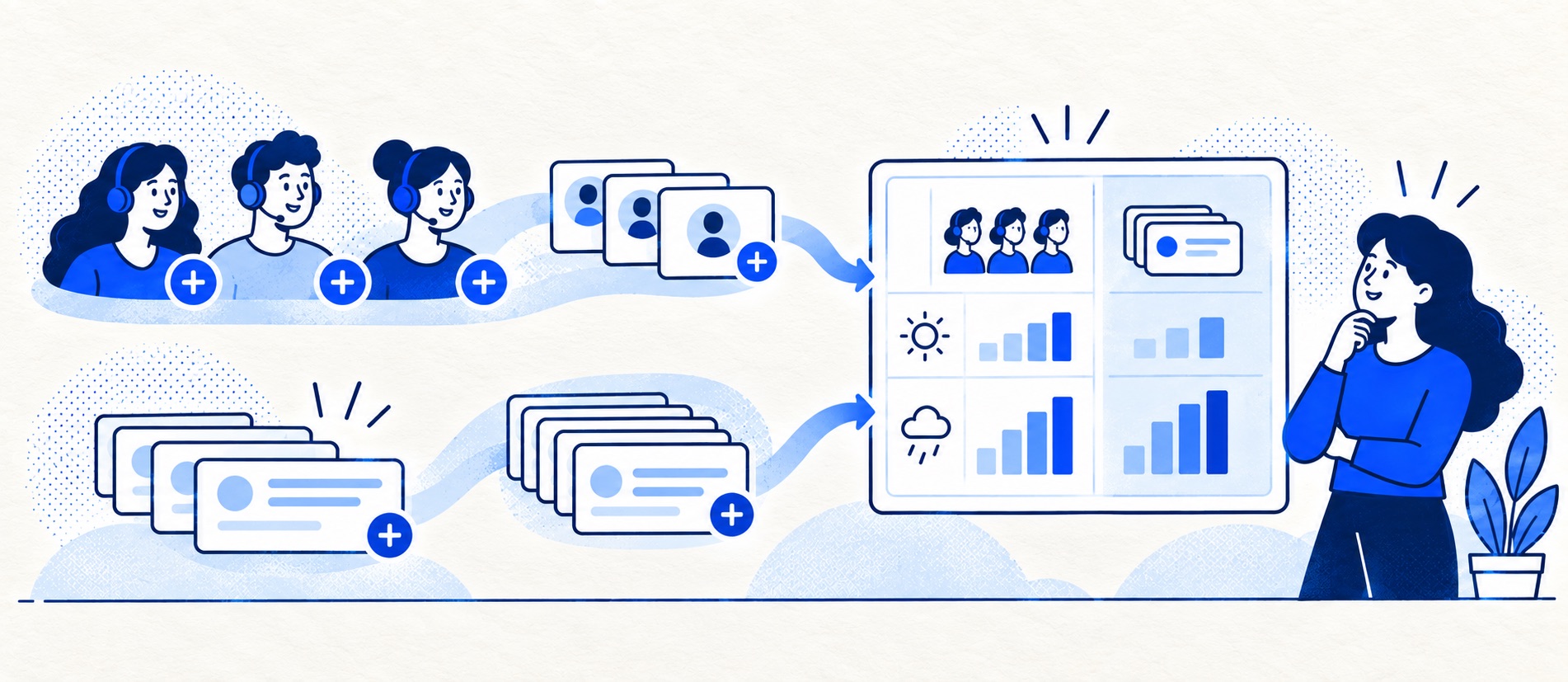
Confirm what counts as an agent, collaborator, ticket and billable event.
Compare the plan containing required features, not headline entry tiers.
Check the next growth step and busiest month before annual billing.
Product shortlist
Compare the charging basis
Gorgias illustrates ticket-volume charging; Freshdesk, HelpDesk and Zendesk illustrate paid-agent or paid-user tiers. Verify current entitlements and billable rules.

Gorgias
Best for: Online shops that need order context and ecommerce actions inside support conversations
Unlike per-seat tools, Gorgias prices its help desk by billable ticket volume. Its strongest case is the depth of its Shopify and ecommerce workflow integrations.
$10/month for 50 ticketsStarter includes 3 agent seats; checked September 2026
Useful strengths
- Deep Shopify order context and actions
- Costs scale by tickets rather than only by agent seats
Watch for
- Overages and AI resolutions need modelling
- Entry plan is email-only and has limited operations features
- 7-day trial
- Shopify-focused
- Ticket-volume pricing

Freshdesk
Best for: Growing teams that need proper ticketing, self-service, automation and reporting
A broad email-first help desk with ticketing, a shared inbox, a customer portal, knowledge base and out-of-the-box reporting on its entry paid plan.
$19 per agent/monthGrowth, billed annually; checked September 2026
Useful strengths
- Ticketing, shared inbox and knowledge base on Growth
- Clearer route into routing, SLAs and custom reporting
Watch for
- Omnichannel needs differ from the email-first Freshdesk plan
- AI and connector usage can add cost
- Free trial
- Email-first help desk
- Per-agent pricing

HelpDesk
Best for: Small teams that want ticketing, website chat and useful automation without an enterprise platform
A focused support workspace combining ticketing, a shared inbox, website chat, messaging channels, automation and reporting in one entry plan.
$19 per user/monthEssential, billed annually; checked September 2026
Useful strengths
- Ticketing, website chat and messaging channels on Essential
- 14-day trial without a credit card
Watch for
- There is no permanent free plan
- Extra AI resolutions can add usage cost
- 14-day trial
- Email, chat and messaging
- Per-user pricing

Zendesk
Best for: Teams that expect multiple channels, mature routing and increasing operational complexity
The Support Team plan supplies core email ticketing, routing, analytics and automations. The broader Suite adds live chat, messaging, telephony and a knowledge base.
£15 per agent/monthSupport Team, paid yearly; checked September 2026
Useful strengths
- GBP pricing and a clear entry ticketing plan
- Strong upgrade path for multichannel operations
Watch for
- Suite Team rises to £45 per agent/month
- Small teams may buy more process than they need
- 14-day trial
- GBP pricing available
- Per-agent pricing
Per-agent and per-ticket pricing answer different commercial questions. A seat-based plan asks how many people need paid access. A volume-based plan asks how many qualifying support conversations you handle. The cheaper model for a two-person team receiving 200 emails may not be cheaper for ten part-time colleagues handling a Black Friday surge.
The advertised unit is only a starting point. Feature tiers, included allowances, minimum users and add-ons can matter more than the charging basis. Use the total-cost guide to finish the comparison after you understand the core variable.
How a per-agent bill changes
The simple calculation is paid users × selected plan price × billing periods. Count everyone who must actually work in the help desk, including supervisors and specialists if their role requires a paid seat. Do not assume an occasional collaborator is free. Check the plan's rules for light users, shared logins and role permissions; sharing one login between agents can damage accountability and security.
At three paid users, adding one colleague raises the seat count by one third. At 30 users, one extra seat has a smaller proportional effect. But a feature-tier upgrade can raise the price for every paid seat at once. Build a second line for the first required upgrade, such as advanced routing or reporting. Zendesk and Freshdesk publish tiered pricing and feature comparisons; the exact needed tier depends on the workflow.
How a per-ticket bill changes
The simple calculation is base allowance + qualifying volume above the allowance at the agreed overage or higher-tier rate. The challenge is defining the unit. Gorgias's billing documentation describes billable events and plan-specific rules. Read those rules rather than treating “one customer issue” as identical to “one billable ticket.” A merged thread, automated interaction or reopened case may be counted differently from your internal reporting convention.
Volume pricing can suit a business with several occasional staff because the bill need not rise for every extra user. It can also be harder to predict when campaigns, fulfilment failures or a new channel lift demand. Watch included agent seats and higher-tier limits too; “per-ticket” does not necessarily mean unlimited staff access.
Compare identical scenarios
| Scenario | Seat model sensitivity | Volume model sensitivity |
|---|---|---|
| One extra agent | Usually another paid seat | May stay inside included seats or require a higher tier |
| Tickets double for one month | Base seats may stay stable; usage extras can still rise | Allowance, overage or tier may change |
| Custom reporting becomes essential | May trigger an upgrade for all seats | May trigger a higher plan regardless of ticket count |
| AI handles routine contacts | AI often has its own unit or add-on | Check how AI and billable-ticket rules interact |
Add a quiet month, a forecast peak and the next staffing milestone. Use your own contact history and include reopens separately. Keep the provider's currency visible and note VAT and annual billing. If a feature is missing from the low tier, do not compare that tier with a complete competitor plan.
Questions that prevent bill shock
Ask for a written definition of an agent, a billable ticket and an AI resolution. Ask what happens at the allowance boundary and whether alerts or hard limits are available. Ask whether a seasonal contractor can be added for a short period, whether seats can be reduced mid-term, and what happens at renewal. Request an itemised quote for all three scenarios.
Then run a help desk pilot with real but safe cases. Observe how the product counts them. A model is useful only if the actual invoice follows the same rules.
A piecewise break-even calculation
The following model is illustrative, not a vendor comparison or market benchmark. Assume all required features are present, a seat plan charges £20 per replying user per month with a one-seat minimum, and a volume plan costs £60 monthly including 300 qualifying tickets and at most three users. Above 300 tickets it charges £0.40 per extra ticket. There are no AI charges, taxes or integrations in this deliberately narrow comparison.
Write the seat cost as S(n) = £20 × max(n, 1). For one to three users, the volume cost is V(t) = £60 + £0.40 × max(0, t − 300). For more than three users, this example's volume plan is ineligible; do not extrapolate its price. The two formulas have different moving parts and a hard eligibility boundary.
| Replying users | Seat plan | 100 tickets | 300 tickets | 800 tickets |
|---|---|---|---|---|
| 1 | £20 | £60 volume | £60 volume | £260 volume |
| 2 | £40 | £60 volume | £60 volume | £260 volume |
| 5 | £100 | Volume plan ineligible | Volume plan ineligible | Volume plan ineligible |
At one or two users, there is no break-even ticket count: the volume base already exceeds the seat bill. At three users, both cost £60 through 300 tickets, then the volume plan becomes more expensive. This is why blindly solving a formula can produce a negative, meaningless threshold. Only solve the overage branch when seat cost is at least the volume base and the required user count is eligible.
What changes at five users?
Suppose a different, fictional five-user-eligible volume tier costs £80 with the same 300-ticket allowance and £0.40 overage. Now £100 = £80 + £0.40 × (t − 300), so equality occurs at 350 tickets. At 349 tickets the volume bill is £99.60; at 350 it is £100; at 351 it is £100.40. At 800 it is £280. The five-user seat bill remains £100 only while its required features and seat rate stay unchanged.
If that seat plan needs an upgrade to £35 per user for a mandatory report, the five-user bill becomes £175. The corresponding boundary is 537.5 tickets: at 537 tickets the volume bill is £174.80 and at 538 it is £175.20. There is no exact equality at a whole ticket. This result belongs to these assumptions alone, not to Freshdesk, Gorgias or another named provider.
Purchased bundles create another discontinuity. A £40 block of 100 extra tickets costs £40 at both 301 and 400 tickets, then £80 at 401. Replace the smooth overage term with block price × ceil(max(0, t − allowance) ÷ block size). Compare actual whole-ticket bills around the boundary rather than reporting a false exact crossover.
Apply the model to public plans carefully
Gorgias's billing guide gives a worked 300-ticket, $60 subscription example with $0.40 per additional ticket. That anchors a per-unit calculation, not a guarantee that every tier uses that rate. Its plan guide has inconsistent Basic seat descriptions, so obtain the eligible user allowance before using a five-user scenario. Freshdesk pricing supplies different Growth and Pro prices; compare the tier containing your required reports rather than assuming Growth has every report.
The next useful question is not merely which line is lower today. Record the next hire, the busiest month and the first must-have feature that changes the tier. Then carry the eligible prices into the twelve-month calculator, where one-offs and internal effort belong.
Sources
The scenario comparison is Support Sorted's editorial judgement; confirm terms in a current provider quote.
Frequently asked questions
Questions readers ask before choosing
Is per-ticket pricing cheaper than per-agent pricing?
It depends on ticket volume, seat count, included allowances and required features. Compare the same real workload in a normal and peak month.
What counts as a billable ticket?
The provider's contract decides. Ask about merged conversations, spam, automated replies, reopened issues, channels and customer follow-ups rather than assuming every ticket record is charged once.
Does a supervisor need a paid agent seat?
It varies by product, role and plan. Check whether view-only or collaborator access is included and whether the supervisor must reply or configure automation.
Which model suits a seasonal business?
A stable seat count can make per-agent bills predictable during demand spikes; volume-based bills may grow with the spike. Model seasonal highs and temporary staffing before deciding.