
Software comparison
Best omnichannel customer-service software
Compare omnichannel customer-service platforms for small teams by channel coverage, shared history, routing, AI costs and the exact plan needed to use them.
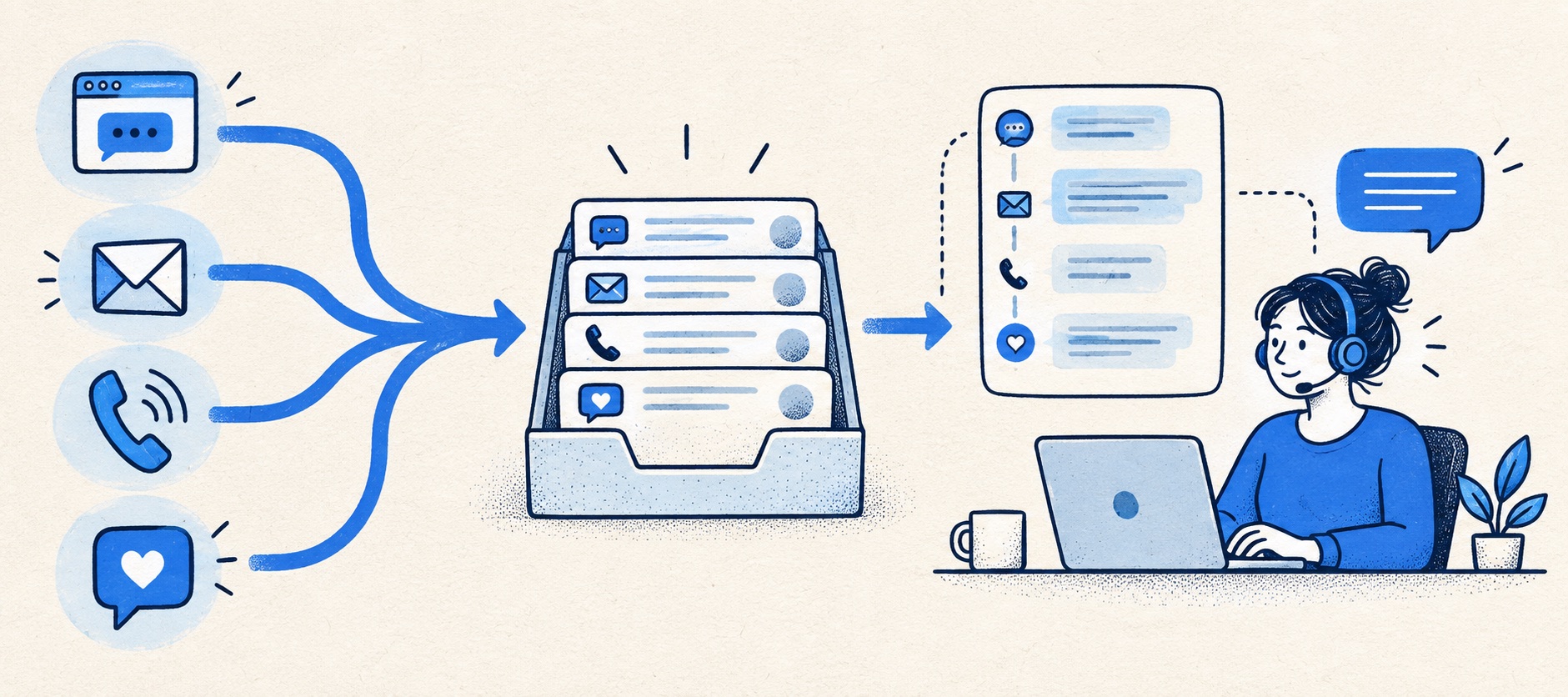
Omnichannel means a customer can move channels without losing context, owner or outcome—not merely that messages appear in one inbox.
Zendesk Support Team and email-first Freshdesk should not be priced as if their broader Suite or Omni capabilities are included.
Test identity matching, duplicate prevention, routing and reporting across a real multi-channel customer journey.
Product shortlist
Omnichannel routes worth comparing
Product cards show general starting references; channel-rich editions may cost more. Logos are official and provider buttons are ordinary links.

Zendesk
Best for: Teams that expect multiple channels, mature routing and increasing operational complexity
The Support Team plan supplies core email ticketing, routing, analytics and automations. The broader Suite adds live chat, messaging, telephony and a knowledge base.
£15 per agent/monthSupport Team, paid yearly; checked September 2026
Useful strengths
- GBP pricing and a clear entry ticketing plan
- Strong upgrade path for multichannel operations
Watch for
- Suite Team rises to £45 per agent/month
- Small teams may buy more process than they need
- 14-day trial
- GBP pricing available
- Per-agent pricing

Freshdesk
Best for: Growing teams that need proper ticketing, self-service, automation and reporting
A broad email-first help desk with ticketing, a shared inbox, a customer portal, knowledge base and out-of-the-box reporting on its entry paid plan.
$19 per agent/monthGrowth, billed annually; checked September 2026
Useful strengths
- Ticketing, shared inbox and knowledge base on Growth
- Clearer route into routing, SLAs and custom reporting
Watch for
- Omnichannel needs differ from the email-first Freshdesk plan
- AI and connector usage can add cost
- Free trial
- Email-first help desk
- Per-agent pricing

Gorgias
Best for: Online shops that need order context and ecommerce actions inside support conversations
Unlike per-seat tools, Gorgias prices its help desk by billable ticket volume. Its strongest case is the depth of its Shopify and ecommerce workflow integrations.
$10/month for 50 ticketsStarter includes 3 agent seats; checked September 2026
Useful strengths
- Deep Shopify order context and actions
- Costs scale by tickets rather than only by agent seats
Watch for
- Overages and AI resolutions need modelling
- Entry plan is email-only and has limited operations features
- 7-day trial
- Shopify-focused
- Ticket-volume pricing

HubSpot Service Hub
Best for: Businesses that want support, sales and marketing activity on one customer record
Free tools cover basic ticketing, inbox and live chat. The dedicated advanced help-desk workspace, knowledge base, SLAs and deeper routing are concentrated in Professional and Enterprise.
Free for up to 2 usersProfessional from $90/seat/month annually plus onboarding; checked September 2026
Useful strengths
- Support history beside CRM, sales and marketing data
- Free entry tools and a large integration marketplace
Watch for
- Advanced help desk features require a large price jump
- Professional has mandatory onboarding cost
- 14-day trial
- CRM-connected service
- Two users on free tools

Tidio
Best for: Small online businesses wanting website chat, ticketing, flows and optional AI in one workspace
A chat-first support workspace with a free 50-conversation monthly allowance, ticketing and separately metered Lyro AI and Flows options.
Free for 50 conversations/monthStarter from $24.17/month annually for 100; checked September 2026
Useful strengths
- Permanent free customer-service allowance
- Shopify app, chat and ticketing in one workspace
Watch for
- Human conversations have a monthly quota
- Lyro AI and Flows have separate allowances and charges
- Free tier
- Conversation-volume pricing
- Optional AI agent

HelpDesk
Best for: Small teams that want ticketing, website chat and useful automation without an enterprise platform
A focused support workspace combining ticketing, a shared inbox, website chat, messaging channels, automation and reporting in one entry plan.
$19 per user/monthEssential, billed annually; checked September 2026
Useful strengths
- Ticketing, website chat and messaging channels on Essential
- 14-day trial without a credit card
Watch for
- There is no permanent free plan
- Extra AI resolutions can add usage cost
- 14-day trial
- Email, chat and messaging
- Per-user pricing
Small teams often buy “omnichannel” because a product lists email, chat, phone, WhatsApp and social logos. The hard part comes later: a customer asks in chat, sends a photo through another channel, then phones when no one responds. If the agent cannot see the history or ownership, the team has five channels but no joined-up service.
The best omnichannel customer-service software is therefore the system that preserves customer identity, issue context and accountable follow-up across the channels your customers actually use. This guide compares practical routes for UK small businesses, based on official plan and integration information checked September 2026.
What to test before buying
List every existing contact route and its monthly volume. Then trace one customer across two or three channels. Does the platform recognise the customer, link the conversations and expose the right order or account details? Does one agent own the work, or can two people answer separately? Can a manager report one issue without counting each channel touch as a separate solved case?
These questions are more useful than a feature tally. A business handling 90% of contacts through email may gain little from a costly voice-and-social suite. A store whose shoppers regularly move from Instagram to onsite chat and email needs stronger identity and order context. Select channels from demand evidence, not fear of missing a feature.
The shortlist by operating model
Zendesk Suite is the broadest conventional service platform here. Suite Team lists messaging, live chat, telephony, knowledge and omnichannel routing in its current UK pricing. Support Team is a cheaper email-and-ticketing route, not the right price reference for the full channel set. Zendesk is compelling when several groups, service policies and customer histories must live in one operation.
Freshdesk Omni is a credible middle route. Its Growth plan lists omnichannel support and an initial Freddy AI Agent session allowance, while higher tiers deepen routing and analytics. It should be compared at the Omni price, not the entry price for email-first Freshdesk. A growing team may find its implementation and plan path more proportionate than a larger service platform.
Gorgias is the specialist choice for ecommerce. It is valuable when agents need Shopify or other supported store context while answering across relevant support channels. The entry Starter plan is constrained, so a genuine multi-channel store must identify the required tier and add any voice, SMS or AI usage. Ticket-volume pricing makes seasonal demand a central budget variable.
HubSpot Service Hub makes sense when support must share a customer record with sales and marketing. It can connect chat, inbox and tickets to CRM context. More advanced help-desk features sit in Professional or higher, with onboarding cost. It is a strategic platform choice rather than the cheapest way to add one new channel.
Tidio can unify chat, email tickets and connected messages for a smaller team. Its human-conversation quota and separate Lyro and Flows allowances make it approachable at low volume but require careful forecasting. It is better framed as a chat-led workspace than as an automatic replacement for a mature contact centre.
HelpDesk is a focused way to centralise tickets, chat and messaging for a smaller operation. It may offer a simpler daily queue than a broad platform. Buyers should inspect the precise channel, history and reporting behaviour on Essential versus Growth, and avoid assuming all advanced supervision or AI capacity is included at the entry price.
Plan boundaries and total cost
| Route | Relevant reference | Budget warning |
|---|---|---|
| Zendesk Suite Team | £45/agent/month paid yearly | Do not substitute the £15 Support Team ticketing price |
| Freshdesk Omni Growth | $29/agent/month annually | AI sessions above the included allowance and connectors can add cost |
| Gorgias | Volume-led help-desk tiers | Channel tier, seasonal tickets and AI outcomes matter |
| HubSpot Service Hub | Professional from $90/seat/month annually | Required onboarding and Credits must be included |
Price the channel set the team needs next year, not only today. Add seats, temporary staff, messaging-provider fees, telephony, number costs, AI sessions or outcomes, integration tasks and implementation time. A vendor may advertise “one inbox” while an important connected channel is supplied by a third party with separate rules.
Identity and duplicate prevention
Customers rarely present the same neat identifier everywhere. An Instagram account, website visitor and email address may belong to one person but not match automatically. Test how agents merge or link records, and what permission or audit trail exists when they do. Incorrectly joining two customers is worse than leaving them separate.
Define a single owner for cross-channel issues. If a shopper sends a direct message after an unanswered email, the team should see the open case and respond once with an accurate update. Rules that automatically create a fresh ticket on every channel can inflate backlog and create contradictory replies. Ask how the system handles merged, reopened and transferred conversations in reporting.
Routing, after-hours and knowledge
Routing should reflect the work: order status, billing, product advice, technical issue and complaint may require different people. Start with a few understandable queues. Too many finely divided rules leave cases stranded, especially in a small team where one specialist is absent. Test what happens when the assigned person is away.
The same approved answer should be available to an agent and to any chatbot or self-service article. A new delivery policy published in one channel but not another can create conflicting promises. Assign ownership to knowledge updates and include channel-specific constraints, such as attachments, conversation windows or provider limits.
After-hours responses should state when a person will reply. An automated acknowledgement is not a completed first response. Give urgent issues a route that matches real staffing rather than suggesting 24-hour coverage because the widget remains visible.
Trial the journey, not the inbox screen
Build five test cases: a new buyer from web chat, an existing customer changing channel, a complaint with an attachment, an order enquiry with several orders, and a case that an AI assistant cannot solve. Use the same cases in each shortlisted product. Score context preserved, number of agent clicks, duplicate handling, correct ownership, customer effort and total cost.
Choose Zendesk Suite for deeper multi-team operations, Freshdesk Omni for a broader but more proportionate service route, or Gorgias when ecommerce order work is the centre. Choose HubSpot when CRM continuity drives the decision; Tidio or HelpDesk can be suitable for a smaller channel mix. The right answer is the simplest platform that keeps the real customer journey intact.
Sources
- Zendesk UK pricing
- Freshdesk Omni pricing
- Gorgias pricing
- HubSpot Service Hub pricing
- Tidio pricing
- HelpDesk pricing
All plan facts come from provider sources. Product-fit conclusions are Support Sorted's editorial judgement.
Frequently asked questions
Questions readers ask before choosing
What is omnichannel customer service?
It is a service model in which a customer can contact a team through several channels while the organisation keeps enough shared context, ownership and history to continue the same issue. A list of connected channels alone is not sufficient.
Is Zendesk Support Team omnichannel?
Support Team is Zendesk's lower-cost email-and-ticketing entry. Suite Team is the published plan that lists messaging, live chat and telephony alongside a knowledge base. Compare Suite pricing for a broad-channel implementation.
Does Freshdesk include omnichannel support?
Freshdesk's email-first help desk and Freshdesk Omni are distinct buying paths. The published Freshdesk Omni Growth plan includes multichannel service and Freddy AI Agent sessions, with additional usage charges to assess.
Which omnichannel tool is best for a Shopify store?
Gorgias is a strong specialist when order context and store actions matter. Zendesk, Freshdesk Omni and Tidio can also fit depending on channel breadth, ticket process and budget. Trial actual cross-channel order cases.