
Startup software comparison
Best customer-support software for startups
Choose customer-support software for a UK startup using free-plan boundaries, four-agent growth budgets and a worked monthly-versus-annual commitment model.
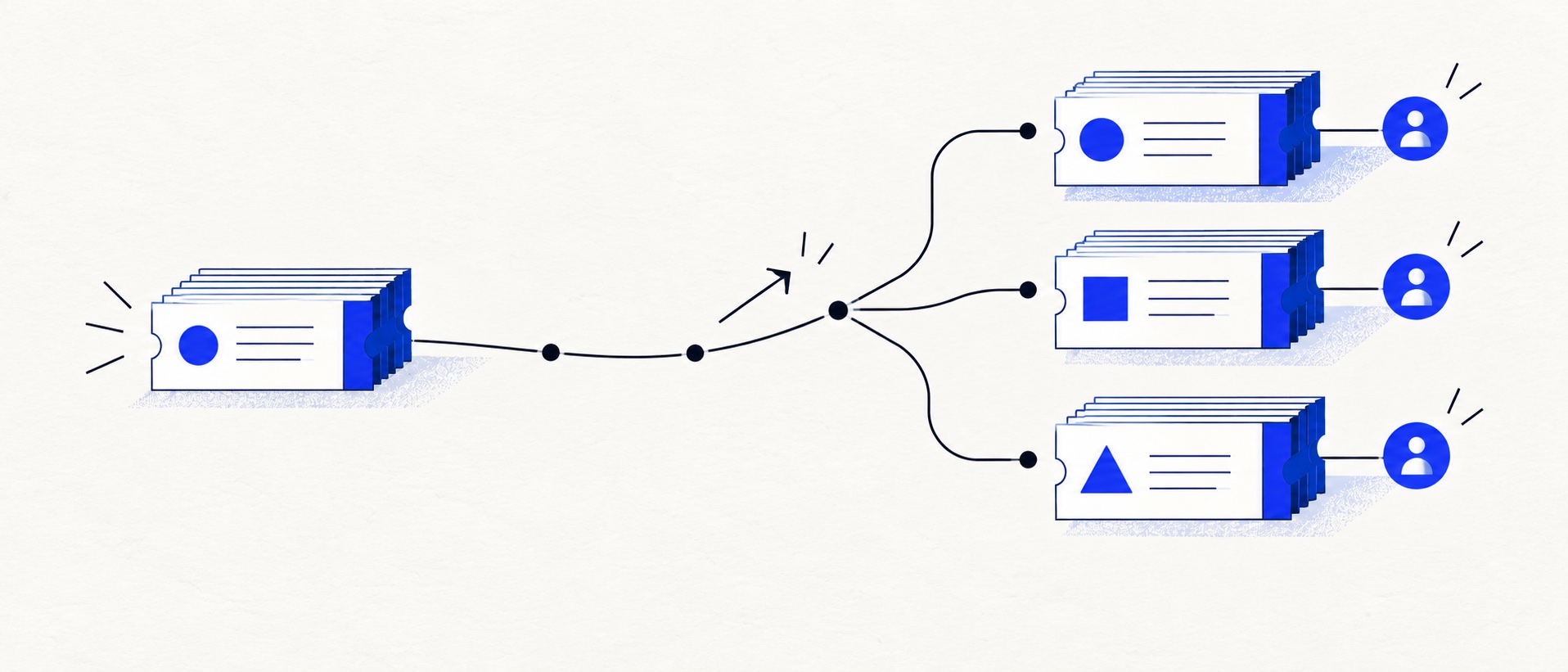
Choose for the support process you will have in twelve months, without paying for an enterprise process today.
Model the bill at the next hiring point and include AI, onboarding and channel costs.
Test ownership, handover, reporting and export with real conversations before signing annually.
Product shortlist
Five sensible startup routes
The products below solve different startup problems. CRM context, a focused queue, free entry and long-term routing depth should not be treated as the same requirement.

HubSpot Service Hub
Best for: Businesses that want support, sales and marketing activity on one customer record
Free tools cover basic ticketing, inbox and live chat. The dedicated advanced help-desk workspace, knowledge base, SLAs and deeper routing are concentrated in Professional and Enterprise.
Free for up to 2 usersProfessional from $90/seat/month annually plus onboarding; checked September 2026
Useful strengths
- Support history beside CRM, sales and marketing data
- Free entry tools and a large integration marketplace
Watch for
- Advanced help desk features require a large price jump
- Professional has mandatory onboarding cost
- 14-day trial
- CRM-connected service
- Two users on free tools

HelpDesk
Best for: Small teams that want ticketing, website chat and useful automation without an enterprise platform
A focused support workspace combining ticketing, a shared inbox, website chat, messaging channels, automation and reporting in one entry plan.
$19 per user/monthEssential, billed annually; checked September 2026
Useful strengths
- Ticketing, website chat and messaging channels on Essential
- 14-day trial without a credit card
Watch for
- There is no permanent free plan
- Extra AI resolutions can add usage cost
- 14-day trial
- Email, chat and messaging
- Per-user pricing

Freshdesk
Best for: Growing teams that need proper ticketing, self-service, automation and reporting
A broad email-first help desk with ticketing, a shared inbox, a customer portal, knowledge base and out-of-the-box reporting on its entry paid plan.
$19 per agent/monthGrowth, billed annually; checked September 2026
Useful strengths
- Ticketing, shared inbox and knowledge base on Growth
- Clearer route into routing, SLAs and custom reporting
Watch for
- Omnichannel needs differ from the email-first Freshdesk plan
- AI and connector usage can add cost
- Free trial
- Email-first help desk
- Per-agent pricing

Zoho Desk
Best for: Budget-conscious teams and businesses already using the Zoho ecosystem
The free edition covers three users and email ticketing. Paid tiers add broader messaging, knowledge-base, reporting, automation and telephony capabilities in stages.
Free for 3 usersPaid plans vary by selected billing currency; checked September 2026
Useful strengths
- Three-user free edition
- Broad channel and Zoho integration range
Watch for
- Plan and currency selectors make budgeting less immediate
- Live chat and advanced routing are plan-dependent
- 15-day trial
- Free edition
- Three users on free plan

Zendesk
Best for: Teams that expect multiple channels, mature routing and increasing operational complexity
The Support Team plan supplies core email ticketing, routing, analytics and automations. The broader Suite adds live chat, messaging, telephony and a knowledge base.
£15 per agent/monthSupport Team, paid yearly; checked September 2026
Useful strengths
- GBP pricing and a clear entry ticketing plan
- Strong upgrade path for multichannel operations
Watch for
- Suite Team rises to £45 per agent/month
- Small teams may buy more process than they need
- 14-day trial
- GBP pricing available
- Per-agent pricing
The best customer-support software for a startup is the one that creates clear ownership without creating an administration job. A two-person founder team needs a reliable queue and customer history. A funded SaaS business may need service targets, routing, a knowledge base and a shared record with sales. An ecommerce startup may care more about order context than conventional ticket fields.
That is why this guide does not name one universal winner. HubSpot Service Hub makes the strongest case when customer support is part of a wider CRM workflow. HelpDesk is easier to justify when the requirement is a focused support queue. Freshdesk provides a balanced route into structured ticket operations, Zoho Desk offers a useful free starting point, and Zendesk suits startups intentionally building a more complex support function.
Quick comparison
| Software | Best startup fit | Starting point | Important upgrade point |
|---|---|---|---|
| HubSpot Service Hub | Support tied to sales and marketing context | Free for up to 2 users | Advanced help desk and knowledge base sit in Professional |
| HelpDesk | A focused shared queue with chat and simple automation | $19/user/month annually | Growth is a substantial step to $79/user/month annually |
| Freshdesk | Conventional ticketing with self-service and reporting | $19/agent/month annually | Advanced routing and multiple SLA policies require Pro |
| Zoho Desk | Bootstrapped teams and existing Zoho users | Free for 3 users | Messaging, knowledge-base and automation depth vary by edition |
| Zendesk | A startup expecting multiple channels and specialist roles | £15/agent/month annually | Suite Team is £45/agent/month for the broader channel set |
Prices exclude applicable VAT. Dollar prices remain in the provider's published currency rather than being converted into a temporary sterling estimate.
What a startup should decide first
Start with the operating model. Record where questions arrive, who replies, which messages need escalation and what customer information changes the answer. If support is mostly email and two people cover it between other jobs, the essential requirements are assignment, collision prevention, internal notes, saved replies and searchable history. If support is already a defined function, add service targets, workload routing, reporting and permissions.
The second decision is where customer context should live. HubSpot is compelling when a support agent needs to see deal history, lifecycle stage and marketing activity. Gorgias may become relevant for a Shopify startup because order actions can happen inside the support conversation. A general SaaS startup usually gets more value from ticket fields, product-area tagging and bug escalation.
Finally, model the next headcount rather than only today's. A $19 per-seat plan costs $38 for two agents and $152 for eight before add-ons. The same growth can make a free plan's limits operationally expensive even while its subscription remains free.
Our startup selection model: which constraint appears first?
A startup's first buying constraint may be cash, a public help library, team access or shared commercial context. We use the illustrative briefs below, rather than a generic score that rewards the product with the most functions. A zero-cost edition is a candidate only if its limits cover the actual work; a more expensive platform is not justified merely because the business expects to grow.
| Illustrative startup brief | Starting candidate | Budget or boundary to record |
|---|---|---|
| 2 founders, basic email queue, no subscription budget | Zoho Desk Free; HubSpot Free if the CRM record matters | $0 subscription, subject to edition limits; user ceilings are 3 and 2 respectively |
| 4 full agents, email and public help articles, standard reports | Freshdesk Growth | 4 × $19 × 12 = $912 annual base |
| 4 full agents, multiple SLA policies and custom dashboards | Freshdesk Pro | 4 × $55 × 12 = $2,640 annual base |
| 4 full Service users, advanced help desk and essential HubSpot CRM context | HubSpot Professional | 4 × $90 × 12 + $1,500 onboarding = $5,820 first-year base plus onboarding |
| 4 agents, messaging and public self-service as firm requirements | Zendesk Suite Team; compare the relevant Freshdesk Omni package | Zendesk base: 4 × £45 × 12 = £2,160; Omni configuration must be priced separately |
These rows are not interchangeable price-ranked bundles. For example, the CRM-led brief can justify a different purchase from an email-and-articles brief, but we assign no assumed revenue or retention gain to that context. HubSpot's full Professional functions require the relevant Service Seats; a viewer is not a free substitute for a replying service user. Its onboarding also belongs in year one, rather than being hidden behind the per-seat figure. HubSpot pricing and the seat catalogue define those inputs.
Plan the fourth user before adopting Free
For a two-founder team, distinguish the first support hire from the next one. Zoho's three-user Free edition can cover three full users, while a fourth exceeds its ceiling. HubSpot's two-user free limit arrives sooner. A public knowledge-base requirement can arrive before either hiring event: Zoho's public library starts on Standard in the edition comparison, while HubSpot's advanced self-service proposition sits in Professional.
Save a simple trigger ledger: the event, the eligible next plan, all required paid users and the budget owner. For four Freshdesk agents, a feature-led move from Growth to Pro changes the annual base by $1,728, calculated as 4 × ($55 − $19) × 12. Calling that increase “the cost of scaling” is too vague if no person was added. Use the free-plan limits guide to record the particular ceiling instead.
Commitment model: a lower rate can require more cash now
For a separate illustrative fixed two-user email-and-chat brief, HelpDesk Essential's published prices give an annual upfront base of 2 × $19 × 12 = $456, versus 2 × $25 = $50 for each monthly subscription. Twelve unchanged monthly payments total $600: a $144 difference. This example excludes tax, usage, refunds, promotions and any later change in seats or features.
If the same configuration is only needed for nine monthly periods, those payments total $450, below the initial $456 annual base. At ten periods they total $500. The arithmetic crossing point is 456 ÷ 50 = 9.12 months, so the first whole monthly period above the annual base is month ten. This is not a cancellation promise: check the applicable terms, payment dates and data-export requirements. It simply exposes the commitment trade-off for a startup whose operating model may change.
Our recommendation is to make the annual saving a deliberate cash decision, not an automatic checkbox. Keep a separate normal-rate renewal budget for startup promotions; a temporary programme should not make the eventual eligible plan look free. Carry the confirmed plan, upcoming hire and implementation allowance into the twelve-month calculator, keeping unknown proration or future discounts outside the stated totals.
HubSpot Service Hub: best when the CRM is central
HubSpot's free service tools cover up to two users and include a shared inbox, basic ticketing, live chat and customer records. That makes the free tier unusually useful for a founder-led team already using HubSpot for leads or sales.
The caution is the jump to the advanced help-desk product. Professional starts at $90 per seat each month on annual terms and has a required $1,500 onboarding fee. The dedicated help-desk workspace, customer portal and knowledge base are part of that more expensive proposition. Buy it because the shared customer platform creates value across teams, not because the startup needs a basic inbox.
HelpDesk: best focused startup queue
HelpDesk Essential costs $19 per user each month when billed annually or $25 monthly. It combines email ticketing, a shared inbox, website chat, Messenger and SMS with automated assignment, canned responses and three ticketing rules. A 14-day trial is available without a card.
This is a coherent package for a startup that wants customer support to feel organised without adopting a broad CRM or enterprise service platform. Model AI usage separately: Essential includes ten AI resolutions a month, after which additional resolutions can add usage cost.
Freshdesk: best balanced ticketing route
Freshdesk Growth costs $19 per agent each month on annual billing. It includes ticketing, a shared inbox, customer portal, knowledge base, reporting, roles and permissions. That gives a startup a credible operating foundation without immediately paying for the Pro tier.
Pro rises to $55 per agent each month annually and adds intelligent routing, custom dashboards, multiple SLA policies and external collaborators. Those features are valuable once queue volume and team structure justify them, but they should be treated as a forecast cost.
Zoho Desk: best free value
Zoho Desk's permanent free edition supports three users and basic email ticketing. It is suitable for a bootstrapped team proving that ticket ownership improves on a shared mailbox. Paid editions add broader messaging, knowledge management, reporting, automation and telephony in stages.
The product is particularly persuasive when the startup already uses Zoho applications. The limitation is plan legibility: set the correct currency and billing term, then verify the exact edition containing every required channel.
Zendesk: best deliberate scaling choice
Zendesk Support Team costs £15 per agent each month when paid yearly and covers email ticketing, routing, prebuilt analytics, prepared responses, customer context and automations. Suite Team costs £45 per agent and adds the knowledge base, messaging, live chat, telephony and omnichannel routing.
Zendesk also advertises a startup programme offering eligible early-stage businesses a six-month Suite trial for up to 50 agents. Treat that as temporary support rather than the long-term cost: model the post-programme bill before building critical workflows around the platform.
A startup trial scorecard
Run the same seven-day test in two products. Import or recreate representative conversations; assign work between two people; route one urgent issue; create one saved reply; find a customer's previous history; produce a basic response-time report; and export the data.
Score each task for time, clarity and plan level. Record every feature that only worked in a higher tier. This exposes whether the attractive entry price actually covers the workflow and gives a future support hire a useful handover document.
Our verdict
Choose HubSpot when support belongs inside a wider CRM process. Choose HelpDesk for a focused queue, Freshdesk for balanced conventional ticketing, Zoho Desk for a cost-conscious start, and Zendesk when the startup is deliberately preparing for multichannel operational complexity.
The strongest startup purchase is not the platform with the longest feature list. It is the one that makes ownership visible now, has a credible next tier and can export the customer history if the business outgrows it.
Sources
- HelpDesk pricing
- Freshdesk pricing
- Zoho Desk pricing
- Zendesk UK pricing and startup programme
- HubSpot Service Hub pricing
- HubSpot seat and service catalogue
- Zoho Desk edition comparison
All plan facts come from provider sources. Product-fit conclusions are Support Sorted's editorial judgement.
Frequently asked questions
Questions readers ask before choosing
What is the best customer-support software for an early-stage startup?
HubSpot is useful when the startup already manages leads and customers in its CRM. HelpDesk is a more focused support choice, while Zoho Desk provides a permanent free route for up to three users. The right answer depends on channels, headcount and customer context.
Can a startup use free customer-support software?
Yes. Zoho Desk has a free edition for three users, and HubSpot offers free service tools for up to two users. Free plans are most useful for proving a workflow; check their reporting, automation, branding and knowledge-base limits before relying on them long term.
When should a startup replace a shared inbox?
Replace it when ownership is unclear, two people can answer the same message, important requests are missed, or the team cannot report on response and resolution times. Those failures matter more than a particular ticket-volume threshold.
Should a startup choose software based on AI features?
AI can help with drafting and repetitive questions, but it should not lead the decision. First verify reliable ticket ownership, searchable history, escalation, reporting and export. Then price AI according to its usage allowance and overage model.
Should a startup pay for its help desk annually?
Annual billing can lower the subscription rate, but the upfront commitment matters when the operating model or funding is uncertain. For two unchanged HelpDesk Essential seats, the published annual base is $456; month-to-month billing is $50 per month. Nine months total $450 and ten $500 before tax and extras. This arithmetic does not assume refunds or future seat changes.