
Small-team buying guide
Best help desks with no minimum seats
Compare help desks that let small teams start without buying a large seat block, including free routes, per-user plans and volume pricing.
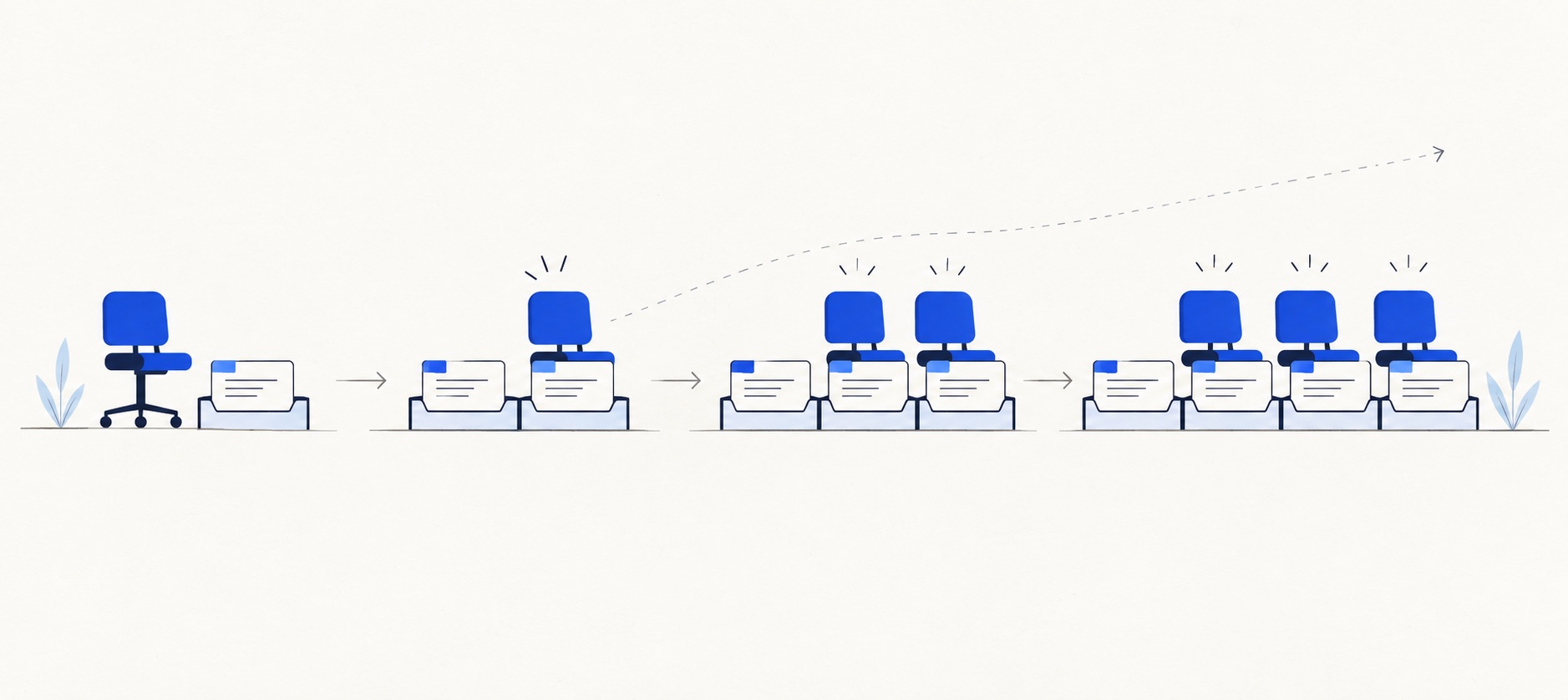
Zoho Desk offers the clearest permanent free route for up to three users; HubSpot has free service tools for two.
HelpDesk, Freshdesk and Zendesk publish per-user or per-agent entry prices without presenting a large team minimum.
[object Object]
Product shortlist
Six help desks small teams can enter proportionately
Compare free, per-user and volume-priced plans without a mandatory seat block.

Zoho Desk
Best for: Budget-conscious teams and businesses already using the Zoho ecosystem
The free edition covers three users and email ticketing. Paid tiers add broader messaging, knowledge-base, reporting, automation and telephony capabilities in stages.
Free for 3 usersPaid plans vary by selected billing currency; checked September 2026
Useful strengths
- Three-user free edition
- Broad channel and Zoho integration range
Watch for
- Plan and currency selectors make budgeting less immediate
- Live chat and advanced routing are plan-dependent
- 15-day trial
- Free edition
- Three users on free plan

HubSpot Service Hub
Best for: Businesses that want support, sales and marketing activity on one customer record
Free tools cover basic ticketing, inbox and live chat. The dedicated advanced help-desk workspace, knowledge base, SLAs and deeper routing are concentrated in Professional and Enterprise.
Free for up to 2 usersProfessional from $90/seat/month annually plus onboarding; checked September 2026
Useful strengths
- Support history beside CRM, sales and marketing data
- Free entry tools and a large integration marketplace
Watch for
- Advanced help desk features require a large price jump
- Professional has mandatory onboarding cost
- 14-day trial
- CRM-connected service
- Two users on free tools

HelpDesk
Best for: Small teams that want ticketing, website chat and useful automation without an enterprise platform
A focused support workspace combining ticketing, a shared inbox, website chat, messaging channels, automation and reporting in one entry plan.
$19 per user/monthEssential, billed annually; checked September 2026
Useful strengths
- Ticketing, website chat and messaging channels on Essential
- 14-day trial without a credit card
Watch for
- There is no permanent free plan
- Extra AI resolutions can add usage cost
- 14-day trial
- Email, chat and messaging
- Per-user pricing

Freshdesk
Best for: Growing teams that need proper ticketing, self-service, automation and reporting
A broad email-first help desk with ticketing, a shared inbox, a customer portal, knowledge base and out-of-the-box reporting on its entry paid plan.
$19 per agent/monthGrowth, billed annually; checked September 2026
Useful strengths
- Ticketing, shared inbox and knowledge base on Growth
- Clearer route into routing, SLAs and custom reporting
Watch for
- Omnichannel needs differ from the email-first Freshdesk plan
- AI and connector usage can add cost
- Free trial
- Email-first help desk
- Per-agent pricing

Zendesk
Best for: Teams that expect multiple channels, mature routing and increasing operational complexity
The Support Team plan supplies core email ticketing, routing, analytics and automations. The broader Suite adds live chat, messaging, telephony and a knowledge base.
£15 per agent/monthSupport Team, paid yearly; checked September 2026
Useful strengths
- GBP pricing and a clear entry ticketing plan
- Strong upgrade path for multichannel operations
Watch for
- Suite Team rises to £45 per agent/month
- Small teams may buy more process than they need
- 14-day trial
- GBP pricing available
- Per-agent pricing

Gorgias
Best for: Online shops that need order context and ecommerce actions inside support conversations
Unlike per-seat tools, Gorgias prices its help desk by billable ticket volume. Its strongest case is the depth of its Shopify and ecommerce workflow integrations.
$10/month for 50 ticketsStarter includes 3 agent seats; checked September 2026
Useful strengths
- Deep Shopify order context and actions
- Costs scale by tickets rather than only by agent seats
Watch for
- Overages and AI resolutions need modelling
- Entry plan is email-only and has limited operations features
- 7-day trial
- Shopify-focused
- Ticket-volume pricing
A help desk should not require a five- or ten-seat commitment when one person currently answers customers. Small teams need an entry route that matches real headcount, while preserving a sensible path into shared ownership, automation and reporting.
The phrase “no minimum seats” needs careful interpretation. Public self-service pricing may allow one agent, but annual contracts, regional checkout and sales-led packages can differ. Some products include several seats inside a volume plan rather than charging one by one. Always confirm the order form before committing.
Quick shortlist
| Product | Smallest practical public route | Best for | Watchpoint |
|---|---|---|---|
| Zoho Desk | Free edition, up to 3 users | Very small value-led teams | Paid-tier feature boundaries |
| HubSpot Service Hub | Free tools, up to 2 users | HubSpot CRM users | Professional price and onboarding |
| HelpDesk | $19 per user monthly, annually | Focused email and chat | Three Essential rules |
| Freshdesk | $19 per agent monthly, annually | Ticketing plus self-service | Growth-to-Pro jump |
| Zendesk | £15 per agent monthly, annually | Service-platform growth | Broader suite costs more |
| Gorgias | $10 for 50 tickets and 3 seats | Low-volume ecommerce entry | Ticket bands and AI usage |
These are entry references, not equivalent packages. A knowledge base, chat, CRM context or advanced routing can make a higher tier the real minimum for your workflow.
1. Zoho Desk: best permanent free route
Zoho Desk advertises a free edition for up to three users. That is particularly useful for a founder, sole trader preparing to hire, or two-person team that wants proper ticket ownership without an immediate subscription.
The free edition should be evaluated as a complete product boundary. Check the required email setup, automation, self-service, reports and integrations. If one missing feature immediately forces a paid edition, record that paid price as the true entry cost.
Zoho is especially attractive when other Zoho applications already hold customer or business data. It is less compelling if the team would adopt an unfamiliar ecosystem only to save the first few months of licence fees.
2. HubSpot Service Hub: best for two CRM-led users
HubSpot offers free service tools for up to two users, making it an accessible route when the business already uses HubSpot CRM. A support conversation can sit on the same customer record as relevant sales and marketing activity.
The important boundary is the jump from simple inbox work to a developed service operation. Starter begins at $7 per seat each month annually, but Professional is $90 per seat annually and carries a $1,500 onboarding fee. Advanced automation or reporting can therefore change the economics sharply.
Choose the free route when the shared CRM record solves a real problem and the workflow remains modest. Do not treat it as a cheap substitute for Professional.
3. HelpDesk: best focused paid route
HelpDesk Essential is advertised at $19 per user each month on annual billing and can be evaluated with a 14-day trial. It combines ticketing, shared-inbox work and website chat in a contained product.
For one or two users, that focus may be preferable to a free system that requires workarounds. The main watchpoints are Essential's three ticketing rules, its included AI-resolution allowance and the cost of the next plan. Write down every route before buying.
HelpDesk suits a small team that wants to establish clear ownership quickly and sees limited configuration as a benefit.
4. Freshdesk: best entry bundle for self-service
Freshdesk Growth is $19 per agent each month on annual billing. It combines email ticketing with a portal, knowledge base and standard analytics, providing a broad baseline for a small support function.
Freshdesk also advertises a separate six-month free programme for two agents, subject to eligibility and programme terms. Treat that as a time-limited programme rather than a permanent public free edition.
The major planning point is Pro at $55 per agent annually. Multiple service policies, intelligent routing and custom dashboards may make Pro the true fit. Freshdesk remains strong when the team will maintain knowledge content and wants a conventional route into support operations.
5. Zendesk: best for future service depth
Zendesk's UK pricing shows Support Team at £15 per agent each month annually. That creates a low per-agent reference without an obvious multi-seat block. Its broader Suite Team is £45 and Suite Professional is £89.
Zendesk is most convincing when the company expects to use its help-centre, channel, routing and reporting depth. A sole user can buy a licence, but a full service platform may be disproportionate for one uncomplicated mailbox.
Map the channel and knowledge requirements carefully. The lowest support plan and the broader suite are not interchangeable.
6. Gorgias: best alternative to per-seat pricing
Gorgias Starter costs $10 each month for 50 tickets and includes three user seats. This is not single-seat pricing, but it avoids forcing a team to buy three separate agent licences. Basic costs $60 for 300 tickets; higher plans increase the volume allowance.
The model can suit an ecommerce business with several occasional users and low contact volume. It can become expensive during busy retail months. AI Agent outcomes add another usage dimension.
Choose Gorgias only when its order context and store actions create value. A non-ecommerce team gains little from pricing around a specialism it will not use.
How to verify there is no hidden minimum
Begin at the provider's public checkout, not a third-party price table. Select the correct country, currency, billing term and tax status. Enter one user where possible and inspect the order summary. If the route moves to sales, ask for the minimum licensed seats, minimum annual value and any mandatory onboarding in writing.
Confirm whether occasional administrators, collaborators or light users require paid seats. Ask how deactivated and replacement users affect billing. For volume plans, define what counts as a ticket and what happens above the allowance.
Finally, check renewal terms. A product can permit one seat but still create risk through annual prepayment or an automatic move to a larger package.
One-seat buying priorities
A sole operator rarely needs elaborate assignment. The valuable features are searchable customer history, consistent replies, reliable email delivery and a clean mobile or browser workflow. Reporting should reveal repeated questions and ageing work without creating a measurement project.
Prepare for the second user by defining status, ownership and internal notes now. Test whether another person can join without seeing inappropriate data and whether conversations can be reassigned cleanly. The best one-seat help desk should make the first handover easier.
Avoid buying on automation count. With one person, a good saved reply and a visible queue may deliver more value than advanced round-robin routing.
Compare total cost, not minimum seats
Build a twelve-month table with the current team, two additional users and the first advanced requirement. Include annual commitment, tax, onboarding, integrations, AI, channel packages and migration time.
For Gorgias, add normal and peak ticket bands. For HelpDesk, count rules and AI resolutions. For Freshdesk, identify whether Pro becomes necessary. For HubSpot, include Professional onboarding if required. For Zendesk, compare Support with the appropriate suite. For Zoho, record the precise paid tier that resolves the free edition's first limitation.
A £0 or $10 start can be excellent, but only if the process does not need to be rebuilt three months later.
Final recommendation
Choose Zoho Desk for the most straightforward permanent free route, HubSpot for two users already centred on its CRM, HelpDesk for focused email and chat, Freshdesk for entry-level knowledge and portal capability, Zendesk for deeper service-platform growth, or Gorgias for commerce workflows and volume-based economics.
All six can be proportionate in the right shape. Verify the actual checkout and contract, then select the smallest plan that covers the complete twelve-month workflow rather than the smallest number printed on the pricing page.
What one, two and five users actually commit to
The following calculations use published annual monthly equivalents checked September 2026, not a checkout guarantee. Tax, AI, integrations and onboarding are excluded unless stated. HelpDesk, Freshdesk and Zendesk present per-user entry rates without a large seat block on those pages; the one-seat arithmetic is conditional on the order form accepting that count. A missing minimum is not evidence that every negotiated contract has none.
| Plan / monthly equivalent | 1 user: equivalent → annual | 2 users: equivalent → annual | 5 users: equivalent → annual | Eligibility / minimum evidence |
|---|---|---|---|---|
| HelpDesk Essential, $19/user | $19 → $228 | $38 → $456 | $95 → $1,140 | Public per-user rate; order-form minimum and required rules must be confirmed |
| Freshdesk Growth, $19/agent | $19 → $228 | $38 → $456 | $95 → $1,140 | Public per-agent rate; same eligibility condition |
| Zendesk Support Team, £15/agent | £15 → £180 | £30 → £360 | £75 → £900 | Core email plan; not the knowledge-base bundle |
| Zendesk Suite Team, £45/agent | £45 → £540 | £90 → £1,080 | £225 → £2,700 | Knowledge base and broader channels change the real entry cost |
| HubSpot Service Hub Professional, $90/Service Seat annually | $90 → $1,080 | $180 → $2,160 | $450 → $5,400 | New-customer catalogue states no additional seat minimum; add $1,500 mandatory onboarding to year one |
| Zoho Desk Free | £0 subscription | £0 subscription | Ineligible: three-user cap | Paid upgrade prices all required licences; select local currency first |
Each paid cell follows users × published annual monthly equivalent, then multiplies by twelve. HubSpot's corresponding year-one vendor totals, including the stated onboarding but excluding tax and extras, are $2,580, $3,660 and $6,900. Its product catalogue distinguishes new from existing customers, so legacy contracts need their own calculation. A monthly payment schedule does not necessarily remove the annual commitment.
Keep the ticket bundle separate
The Gorgias plan guide lists Starter at $10 monthly, 50 tickets and three seats. For one or two users that is the same $10 base, or $120 across twelve unchanged monthly renewals; $120 is a projection, not an annual-price offer or a twelve-month commitment. Five users exceed Starter's cap. The Basic table and surrounding prose disagree on its user allowance, so this analysis deliberately does not calculate a five-user Basic price.
This is a practical unresolved evidence point, not a reason to pick an arbitrary seat count from whichever sentence makes the product look cheaper. Record the allowed replying users in the provider's current plan terms before choosing. Ticket overages and AI remain separate even when the seat bill does not change.
The minimum-seat sensitivity
Consider a fictional £20-per-user plan with a three-paid-seat minimum. One, two and three users each pay £60 monthly equivalent and commit £720 annually. Five users pay £100 equivalent and £1,200 annually. The second and third user have zero marginal licence cost because those seats were already purchased; the fourth adds £20 monthly. Zero marginal cost is not the same as a free plan.
For a sole trader, the annual difference between an accepted one-seat order and that three-seat minimum is (3 − 1) × £20 × 12 = £480. That is why the checkout minimum, feature-eligible tier and term belong beside every entry price. Use the calculator to enter the confirmed minimum and cap. If the next user exceeds the cap, it asks for the next tier rather than assuming the entry rate continues.
Sources
- Zoho Desk pricing
- HubSpot Service Hub pricing
- HelpDesk pricing
- Freshdesk pricing
- Zendesk UK pricing
- Gorgias pricing
All plan facts come from provider sources. Product-fit conclusions are Support Sorted's editorial judgement. Confirm minimum commitments in the provider's order form or written quote.
Frequently asked questions
Questions readers ask before choosing
What does no minimum seats mean?
It means a buyer can start without purchasing a large compulsory block of agent licences. It does not mean the product is free or that every feature is available to one user; plans, contracts and included-seat rules still need checking.
Which help desk is free for three users?
Zoho Desk advertises a permanent free edition for up to three users. Confirm that its channels, automation and reporting limits cover the intended workflow before relying on it.
Can a sole trader use a help desk?
Yes. A one-person desk can create searchable history, consistent replies and a clean handover path before the first hire. Avoid paying for complex routing or reporting that one operator will not use.
Is per-agent pricing always best for a small team?
No. Per-agent pricing is easy to understand, but volume pricing can suit a larger low-volume team and free tiers can suit simple workflows. Compare normal and peak contacts, active users and the plan containing required features.